

Let's learn about Dynamic Programming via these 50 free blog posts. They are ordered by HackerNoon reader engagement data. Visit the Learn Repo or LearnRepo.com to find the most read blog posts about any technology.
Dynamic programming is a method for solving complex problems by breaking them down into simpler overlapping subproblems and storing their results. It matters for efficiently tackling optimization challenges in computer science, significantly improving algorithmic performance.
1. Kadane’s Algorithm Explained with Examples
 Given an array, the algorithm to find the maximum subarray sum is called Kadane’s Algorithm.
2. Real-world Use Cases of Dynamic Programming
 Applications of dynamic programming
3. Understanding Dynamic Programming So You Can Use It Effectively
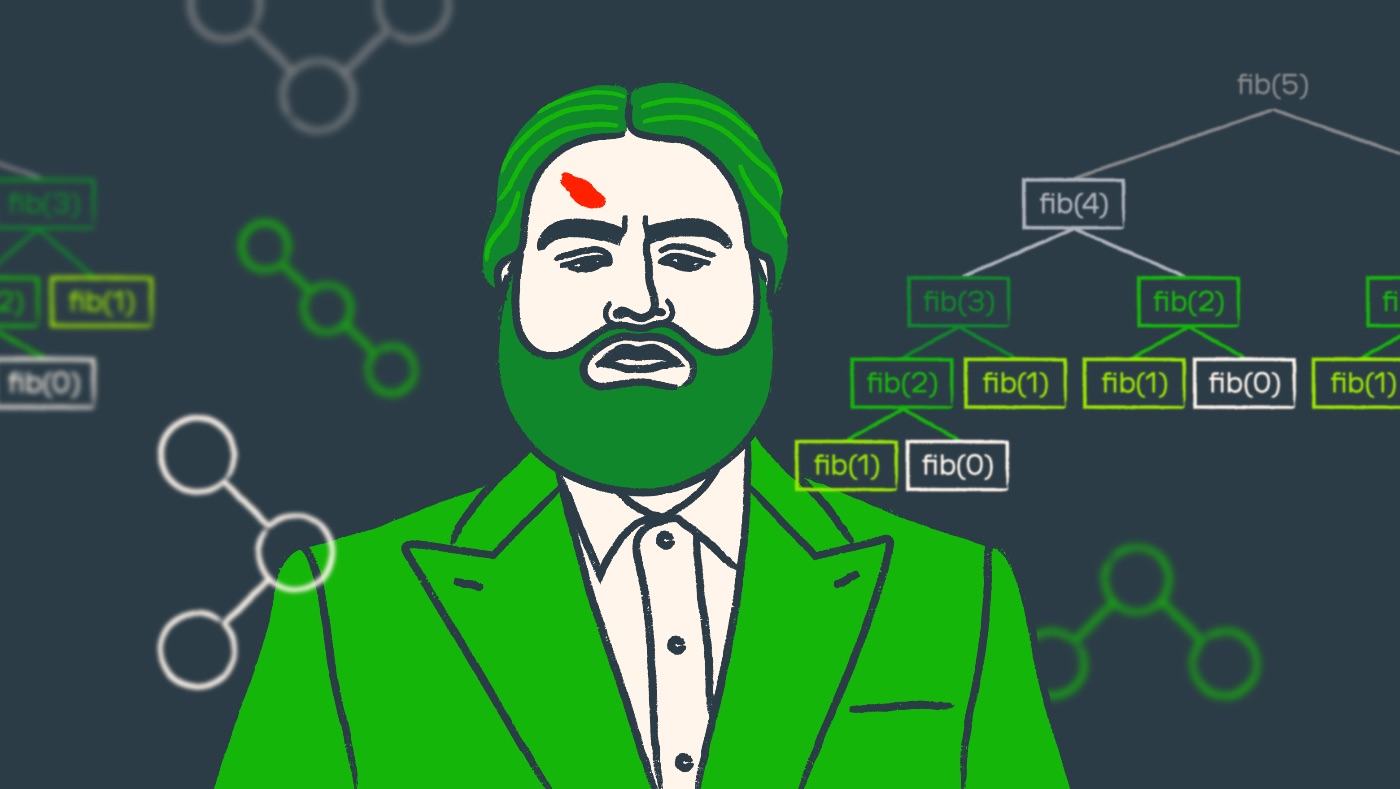 I’ll discuss Dynamic Programming (DP) and how to use previous computation experience effectively. I hope you will find it interesting.
4. How to solve Unique path problem
 Dynamic programming approach.
5. Solving the ATM problem with Dynamic Programming
 Solving ATM problem with Dynamic Programming
6. The ATM Problem: Why the Greedy Algorithm Isn't an Optimal Solution
 Solution to a popular Interview problem: Solve ATM task with Greedy Algorithm
7. All You Need to Know About Dynamic Programming
 What is dynamic programming and why should you care about it?
8. Shelf Labels In Dynamics 365 For Finance and Operations
 Shelf label is nothing but labels to put on a rack or a shelf where an item is stored. These labels are printed and put on store rack or shelf. For example, when you go to a supermarket you can see labels are displayed with various information where the product is stored.
9. Solving the Edit Distance Problem Using The Dynamic Programming Approach
 The first question that arises when solving a problem using dynamic programming(DP) is how to figure out that DP is a way to solve it?
10. A n00b's Guide To Data Structures and Algorithms
 We are going to start a series of lessons based on Data Structures and Algorithms.
11. Using Memoization In Python To Speed Up Slow Functions
 Memoization is an optimization technique that speeds up programs by caching the results of previous function calls. Python 3 makes it easy to memoize functions.
12. How to Solve 6 Dynamic Programming Problems In a Systematic Way
 In this article, I gave you an introduction to Dynamic Programming with several examples. Here I will solve 6 harder Dynamic Programming problems to show you how to approach them.
13. Dynamic Programming: Using Memoization to Improve Your Javascript Functions
 In this article, we will learn about what memoization is, what value memoization provides to Javascript developers, and how to use it to improve JS functions.
14. What Is Dynamic Programming?
 This article is for them, who have heard about Dynamic Programming and for them also, who have not heard but want to know about Dynamic Programming (or DP) . In this article, I will cover all those topics which can help you to work with DP .
15. House Robber
 You need to solve this: given an integer array nums representing the amount of money of each house, return the maximum amount of money you can rob tonight.
16. Do Not Fear Dynamic Programming (Part 1)
 Dyanmic Programming isn't as hard as people think. We'll break it down in this guide.
17. The Avalanche Algorithm — How To Calculate the Maximum Possible Path in a Binary Tree
 In this article we try to calculate the maximum possible path in a binary tree, describing a more efficient method than the brute force solution.
18. Tech Interview Tips: Solving The Trapping Rainwater Problem
 Learn how top tech giants are raising the bar in coding interviews with challenging Trapping Rainwater problem-solving strategies.
19. Grokking Dynamic Programming (Part 2)
 Part 2 on my series about dynamic programming problems and coding techniques to solve them.
20. What Is Dynamic Programming and Memoization?
 Learning Dynamic Programming and Memoization in Under 5 Minutes
21. Bayesian Persuasion in Sequential Trials: Assumptions and induced strategies
 Optimal Signaling in Two-phase Trials: Exploring Induced Strategies for Binary-outcome Experiments.
22. Analyzing Optimal Signaling with Binary-outcome Experiments in Two-phase Trials
 Explore optimal signaling strategies for binary-outcome experiments in two-phase Bayesian persuasion trials.
23. What Makes AI Work? A Breakdown of the Key Proofs
 Easy-to-follow explanation of the key lemma in RL with step-by-step proof breakdown.
24. How Prior Studies Have Advanced Value Iteration and Acceleration in Reinforcement Learning
 Review prior works on value iteration, RL algorithms, and acceleration methods, including Nesterov and Anderson acceleration, in dynamic programming and RL.
25. Understanding Incentive-Compatible Signaling in Two-Phase Trials
 Explore how incentive compatibility (IC) requirements shape the sender's experiment design in phase I of two-phase trials.
26. How to Maximize Persuasion Ratios in Two-Phase Trials
 Discover how to optimize the persuasion ratio and signaling structure in two-phase trials.
27. A Smarter Solution to Speeding Up AI Training
 Anc-VI accelerates classical value iteration (VI) to achieve optimal convergence rates. This work opens new directions for RL optimization.
28. Exploring Sender Constraints in Two-Phase Bayesian Persuasion Trials
 In two-phase Bayesian persuasion trials, explore how predetermined binary-outcome experiments in phase II impact the sender's optimal strategy.
29. How Optimal Signaling Outperforms Classical Bayesian Strategies in Multi-Phase Trials
 Explore how the optimal signaling strategy outperforms classical Bayesian persuasion strategies in binary state scenarios.
30. Markov Decision Processes and Value Iteration in Reinforcement Learning
 Explore the fundamental concepts of MDP and RL, including Bellman operators, Q-value functions, and value iteration for optimal reinforcement learning.
31. Unpacking Key Proofs in Reinforcement Learning
 Explore simplified explanations of key proofs in reinforcement learning.
32. How Do Signal Constraints Affect Bayesian Persuasion in Multi-Phase Trials?
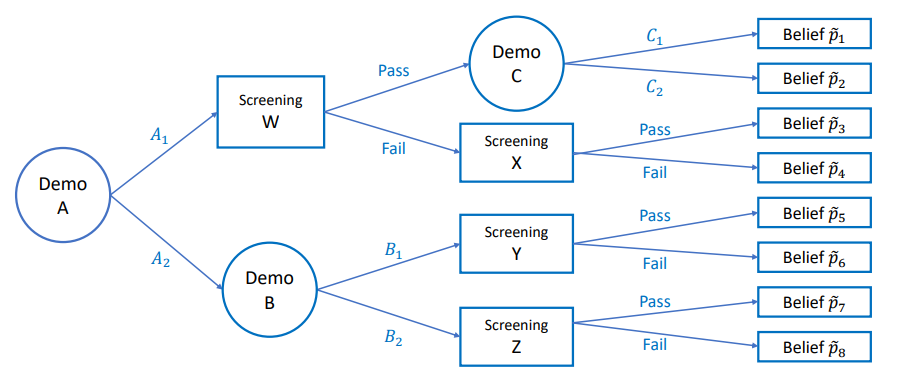 Explore a Bayesian persuasion framework in multi-phase trials where the sender faces constraints on signals due to exogenous experiment determinations.
33. Anc-VI Sets New Standards in Speed for Bellman Consistency in Reinforcement Learning
 Discover Anc-VI’s accelerated convergence rate for Bellman consistency, providing faster value iteration for reinforcement learning applications.
34. A Faster Path to Smarter AI: The New Anc-VI Method
 Discover Anc-VI, an accelerated value iteration method that speeds up reinforcement learning convergence, improving Bellman error reduction.
35. Formulating Optimal Signaling Strategies in Constrained Bayesian Persuasion Trials
 Discover how constraints in multi-phase trials shape optimal signaling strategies in Bayesian persuasion.
36. Anchored Value Iteration and Its Impact on Bellman Consistency in Reinforcement Learning
 Learn how Anc-VI accelerates Bellman consistency in value iteration, setting the stage for faster reinforcement learning convergence.
37. How Approximate Anchored Value Iteration Handles Errors in Decision-Making Models
 Learn how Approximate Anchored Value Iteration (Apx-Anc-VI) remains robust against evaluation errors of the Bellman operator.
38. Making Sense of AI Learning Proofs
 Simplified insights from Reinforcement Learning proofs, designed for new learners to easily grasp complex ideas.
39. Generalizing Signaling Strategies in Multi-phase Trials
 Explore the relationship between multi-phase trials and single-phase Bayesian persuasion models.
40. Breaking Down Complex Concepts in Reinforcement Learning
 A simplified guide to understanding Theorem 5’s proof in RL, breaking down complex concepts for beginners.
41. How Anc-VI Helps AI Learn Faster with Optimality Operators
 Explore how Anc-VI accelerates convergence for the Bellman optimality operator, achieving faster rates in RL compared to standard value iteration
42. Anc-VI Sets a New Standard for Reinforcement Learning Optimization
 Learn how Anc-VI's complexity lower bound proves its optimality. Discover the span condition’s role in establishing performance limits in optimization theory
43. My Journey Into Predicting States Using Emoji Observations With Viterbi Algorithm
 See the implementation of the Viterbi algorithm in Python
44. Why Anc-VI is Crucial for Undiscounted Reinforcement Learning
 Discover how Anc-VI converges to fixed points in undiscounted MDPs (γ = 1), addressing challenges typically overlooked in traditional DP and RL theory.
45. Foundational Lemmas for Bellman Optimality and Anti-Optimality Operators
 Explore key lemmas about Bellman optimality and anti-optimality operators.
46. Breaking Down the Inductive Proofs Behind Faster Value Iteration in RL
 Explore the omitted proofs for Theorem 2, including the inductive approach to establishing the accelerated convergence rates for the Bellman optimality and anti
47. A Dynamic Programming Approach to Optimizing Signaling Strategies in Multi-phase Trials:
 Learn how dynamic programming can optimize signaling strategies in multi-phase trials with binary-outcome experiments.
48. Gauss-Seidel Anchored Value Iteration and Its Benefits
 Learn about Gauss-Seidel Anchored Value Iteration, a method combining anchoring with Gauss-Seidel updates to improve convergence in finite state-action spaces.
49. Optimizing Signaling Strategies with Sender-Designed Experiments in Multi-phase Trials
 Explore how determined and sender-designed experiments influence signaling strategies in multi-phase trials.
50. The Noonification: Understanding Dynamic Programming So You Can Use It Effectively (9/4/2023)
 9/4/2023: Top 5 stories on the Hackernoon homepage!
Thank you for checking out the 50 most read blog posts about Dynamic Programming on HackerNoon.
Visit the /Learn Repo to find the most read blog posts about any technology.