
Let's learn about Mathematics via these 153 free blog posts. They are ordered by HackerNoon reader engagement data. Visit the Learn Repo or LearnRepo.com to find the most read blog posts about any technology.
I don't like math, but you might. The wonderous world of numbers awaits!
1. Kadane’s Algorithm Explained with Examples
 Given an array, the algorithm to find the maximum subarray sum is called Kadane’s Algorithm.
2. Calculating the Square Root of a Number using the Newton-Raphson Method [A How To Guide]

3. Manacher’s Algorithm Explained— Longest Palindromic Substring
 Manacher’s Algorithm helps us find the longest palindromic substring in the given string. It optimizes over the brute force solution by using some insights into how palindromes work. How? Let’s see!
4. Implementing 3x+1 or Collatz Conjecture In Python
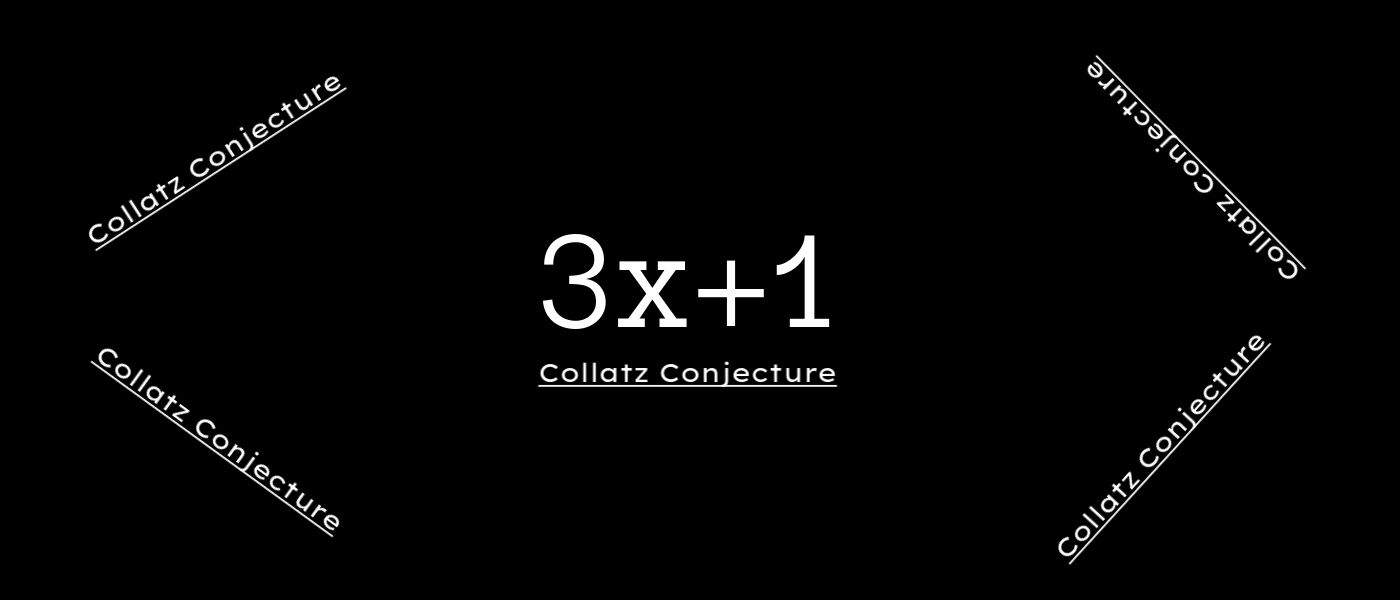 3x+1 or Collatz conjecture is a simple maths problem that can easily be implemented using a simple while loop in Python.
5. A Guide to Two's Complement: Calculating And Converting For Binary Numbers
 Modern computers today use a binary number representation system called 'Two's complement'. It is a fixed number of binary digits used in computer calculations. Basic math operations such as addition and subtraction can be performed using the binary rules of addition and subtraction. Two's complement is not a complex scheme and is rather very simple to work with. This system also helps overcome the shortcomings of having to deal with magnitudes. Two's complement can be characterized as:
6. Java Program to Check for Right Angled Triangle
 A simple program in Java to check whether a triangle is right-angled or not.
7. Formulas of Uniswap: A Deep Dive
 Find out the benefits of concentrated liquidity for multiple pooled assets in Uniswap.
8. Absolute Fundamentals of Machine Learning
 Machine learning, what a buzzword. I’m sure you all want to understand machine learning, and that’s what I’m going to teach in this article.
9. Introduction To Maths Behind Neural Networks
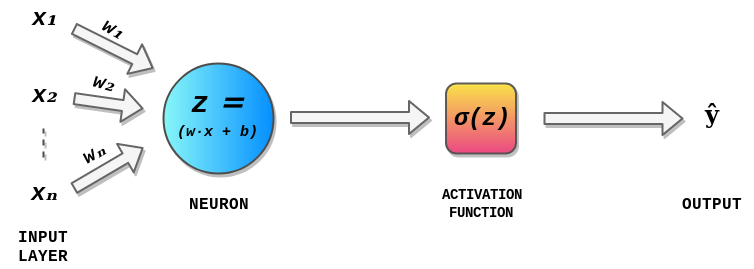 Today, with open source machine learning software libraries such as TensorFlow, Keras or PyTorch we can create neural network, even with a high structural complexity, with just a few lines of code. Having said that, the Math behind neural networks is still a mystery to some of us and having the Math knowledge behind neural networks and deep learning can help us understand what’s happening inside a neural network. It is also helpful in architecture selection, fine-tuning of Deep Learning models, hyperparameters tuning and optimization.
10. Understanding Boolean Methods in Ruby With Examples
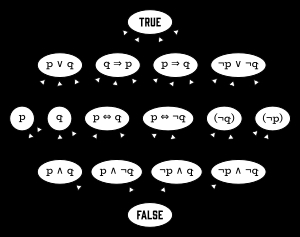 Most programming languages have a Data Type called “Boolean”. This is
a form of data with only two possible values (usually “true” and
“false”). The Ruby language however does not have a Boolean Data
Type.
Most programming languages have a Data Type called “Boolean”. This is
a form of data with only two possible values (usually “true” and
“false”). The Ruby language however does not have a Boolean Data
Type.
11. Table of Transposed Numbers.
 The transposition of figures is a frequent cause of errors in proving accounts and balance sheets.
12. Neural Network Layers: All You Need Is Inside Comprehensive Overview
 Explore an in-depth overview of various neural network layers, their history, mathematical formulations, and code implementations. The publication covers common
13. Christmas Special: Games That Will Help You Understand Complex Math Concepts
 Games like chess and tic-tac-toe are games that have been with us for centuries and many people find them boring. What happens if they get really complicated?
14. You Could Be Wrong About Probability
 A quick walkthrough of the three frameworks in probability viz. classical, frequentist and Bayesian through an example.
15. Math GPT: Can AI Help Solve Unified Theory ?
 What if we trained AI to complete equations instead of images of Cats?
16. The REAL Life of Pi: Ethereal, Romantic, Mysterious And Completely Memorizing
 “Probably no symbol in mathematics has evoked as much mystery, romanticism, misconception and human interest as the number Pi” ~William L. Schaaf, Nature and History of Pi. π
17. Must-Know Theorems for Programmers
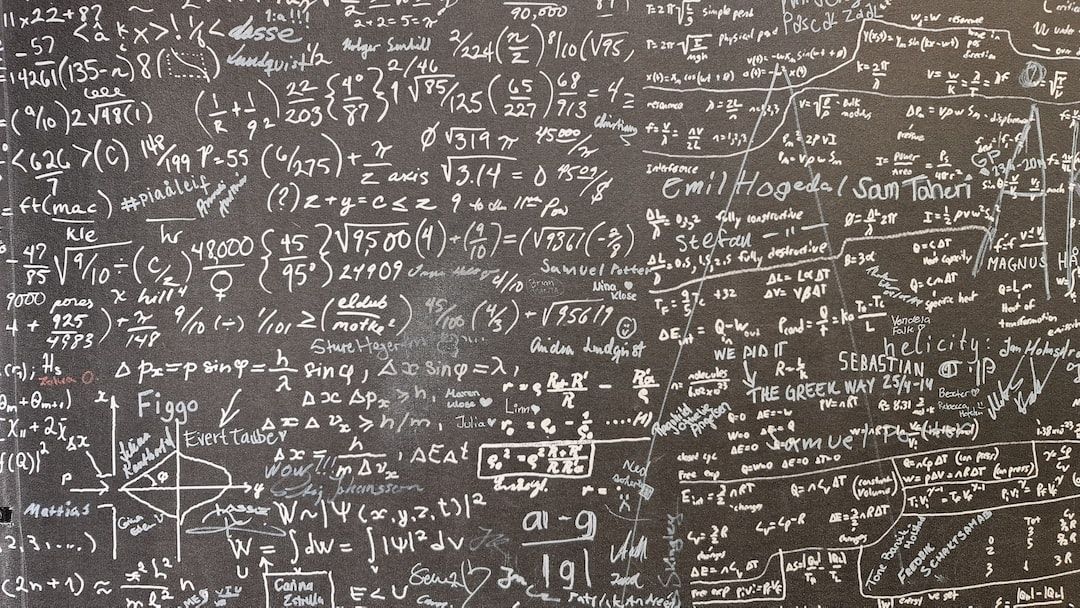 Programming is a complex and multifaceted field that encompasses a wide range of mathematical and computational concepts and techniques.
18. Understanding C++20 <chrono> in the Context of Quantitative Finance
 Modern C++20 chrono library usage in quantitative finance for fixed income securities pricing
19. Flax: Google’s Open Source Approach To Flexibility In Machine Learning
 Thinking of Machine Learning, the first frameworks that come to mind are Tensorflow and PyTorch, which are currently the state-of-the-art frameworks if you want to work with Deep Neural Networks. Technology is changing rapidly and more flexibility is needed, so Google researchers are developing a new high performance framework for the open source community: Flax.
20. Prefix Sums and How They Can be Used to Solve Coding Problems
 In this post, we will look at prefix sums and how they can be used to solve a common coding problem, that is, calculating the sum of an array (segment). This article will use Java for the code samples but the concept should apply to most programming languages.
21. What we need to know about Rounding and Midpoint
 Round a Number: Rounding a number means obtaining an approximate value that allows it to be used without cluttering up with useless precision for what we want to do, but in such a way that this approximation remains as close as possible to the exact value.
22. 🚨 The Last Human Bastion Fell: GPT-5 Just Redefined Discovery with Original Math
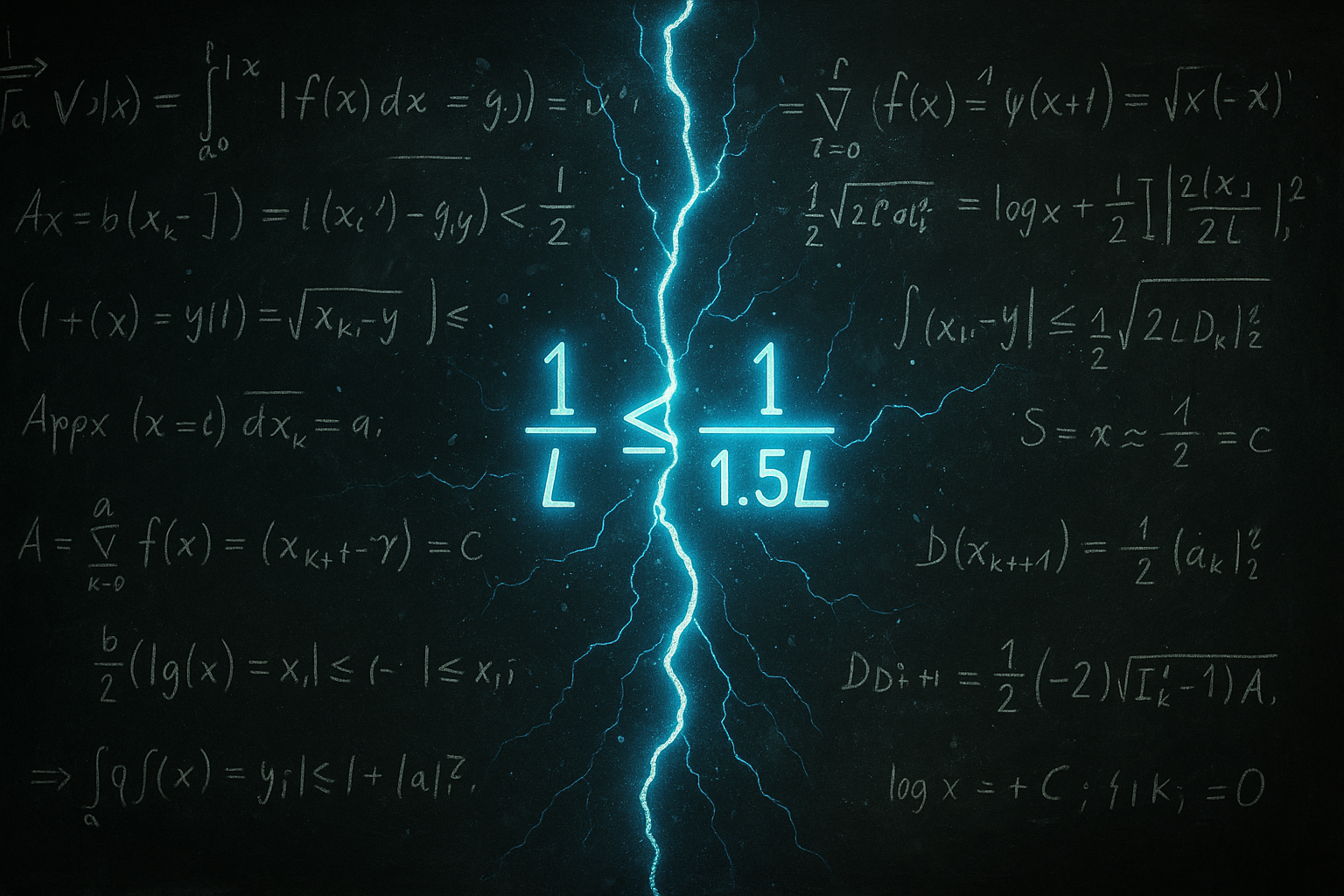 GPT-5 solved original math, ending humanity’s monopoly on discovery. Ronnie Huss breaks down what this means for AI, science, and the frontier ahead.
23. Everyone's Using the Wrong Algebra in AI
 From Tesla phantom braking to LLM hallucinations, the root bug is first-order math. We explain how dual/jet numbers unlock scalable second-order AI.
24. Fixed point math in Solidity
 It always seems impossible until it’s done. — Nelson Mandela
25. Divide and Conquer: Karatsuba Integer Multiplication
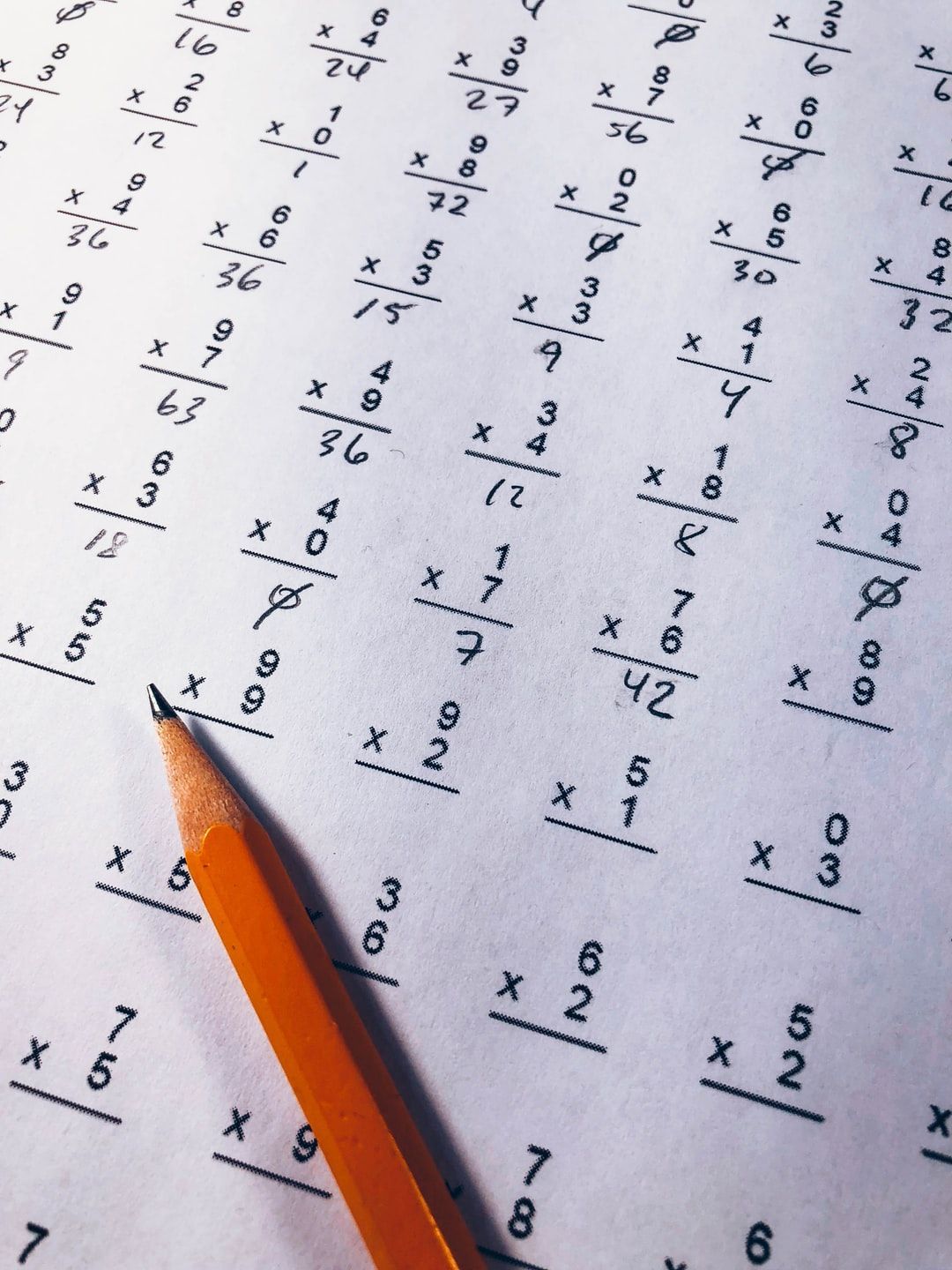 Karatsuba algorithm's explanation with examples and illustrations.
26. The Mind-Bending World of Heuristic Emergence Might Mean We're Artificial
 Imagine winning the lottery!
27. How to Select a Random Node from a Tree

28. How to Calculate Cross Product and Rectangle Area in 3 Easy Steps
 Albeit the dot product of two vectors gives a scalar, in contrast, the resultant vector is a vector of cross-products.
29. The Fatal Math Error Killing Every AI Architecture - Including The New Ones
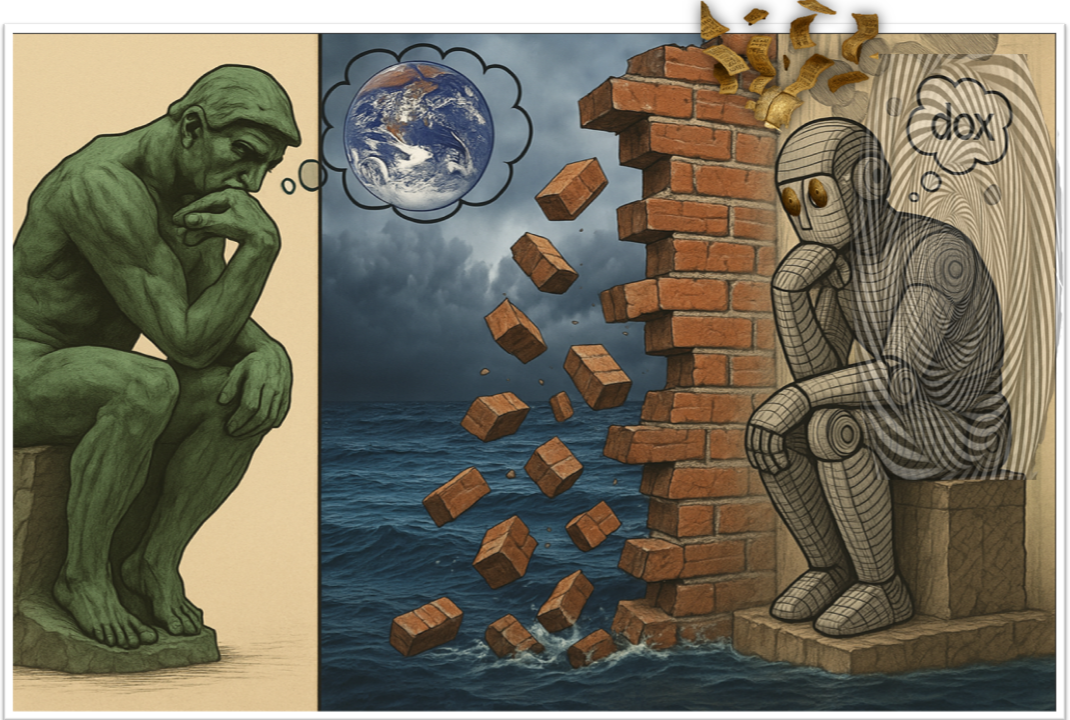 AI's Fatal Flaw: Why JEPA, LLMs & Transformers Can't Escape the Flatland, until Toroidal Math
30. Why Math Functions in C++ Are So Slow
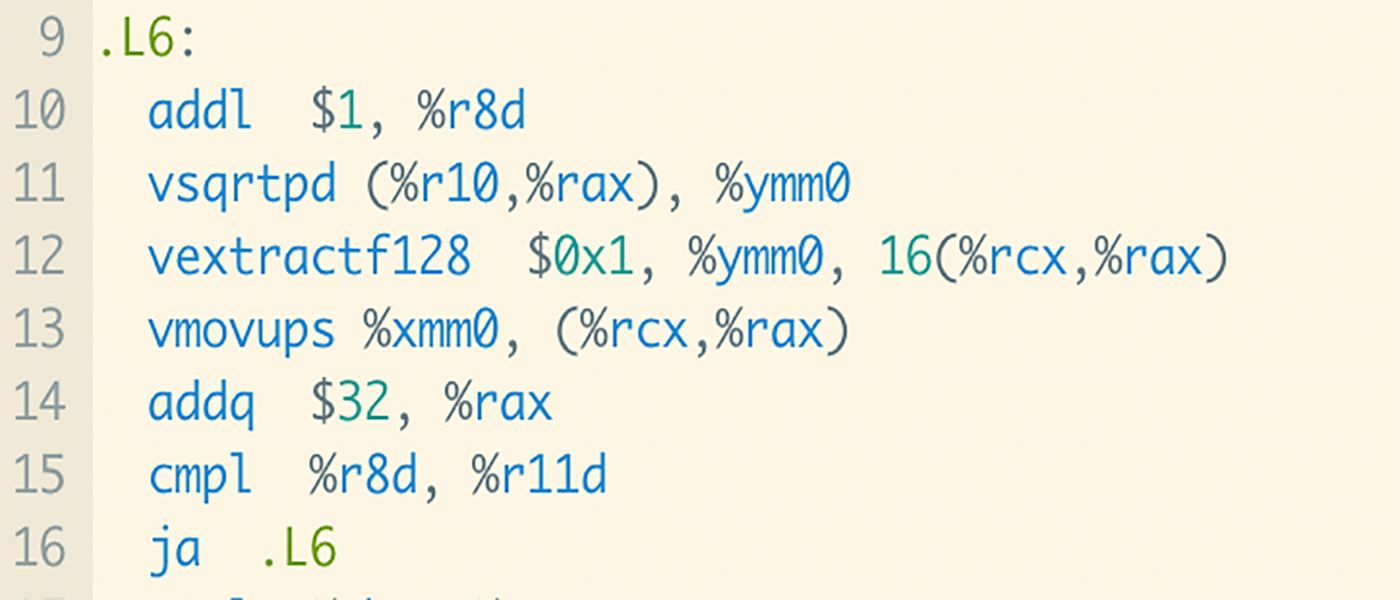 Why C++ math functions can be slow and how to fix them
31. Fenwick Tree Explained
 Fenwick Tree is an interesting data structure that uses binary number properties to solve point update and range queries in your code in some situations.
32. Solving Matrix Algebra in JavaScript [An Overview]
 Many problems, especially in scientific computing, end up being formulated as matrix operations. This can be anything from PDE-solvers (PDE - Partial Differential Equation) up to image-processing or ML-algorithms.
33. Object Detection Using Single Shot MultiBox Detector (A Case Study Approach)
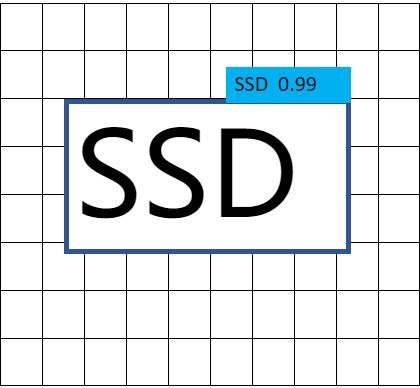 This blog post delivers the fundamental principles behind object detection and it's algorithms with rigorous intuition.
34. Java Program to Generate Multiplication Table of the Input Number
 Java program to display the multiplication of the input number from 1 to 10.
35. The Math Behind the Bulb Switcher Challenge: How Many Bulbs Will Remain On After N Rounds?
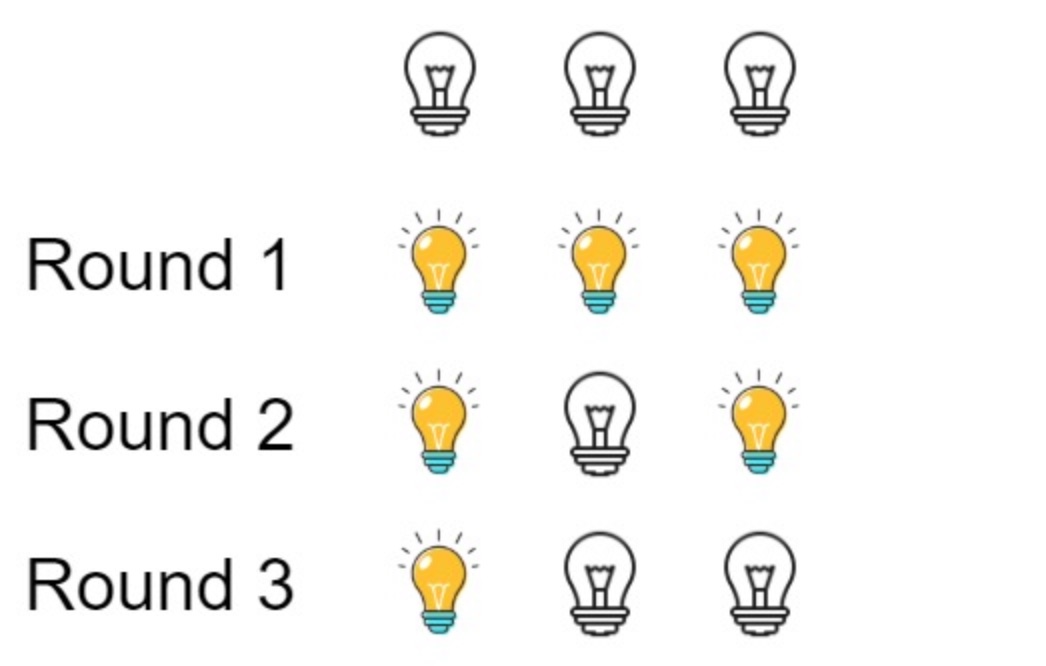 This article describes several solutions and approaches to the "Bulb Switcher" problem.
36. Re: George Hotz, Simulation Theory, Stephen Wolfram, "God and Dice"
 When asked about the universe, its origin, and life in general, what comes to mind? The answer has fathomed scientist, theologians, philosophers and man for decades. I can go from the philosophical standpoint of being like, I am a Copt, here is what I believe. You and me, could go back and forth discussing what is truth, and all that. However, this isn't the point of this post. I want to look at the question of, "a universal theorem of everything". The whole universe and how it is tied in general is that of a physics standpoint. We are at the dawn of age of exploration really, and still mankind has a question on what unifies nature itself.
37. Making A Drawing Application on the Desmos Graphing Calculator
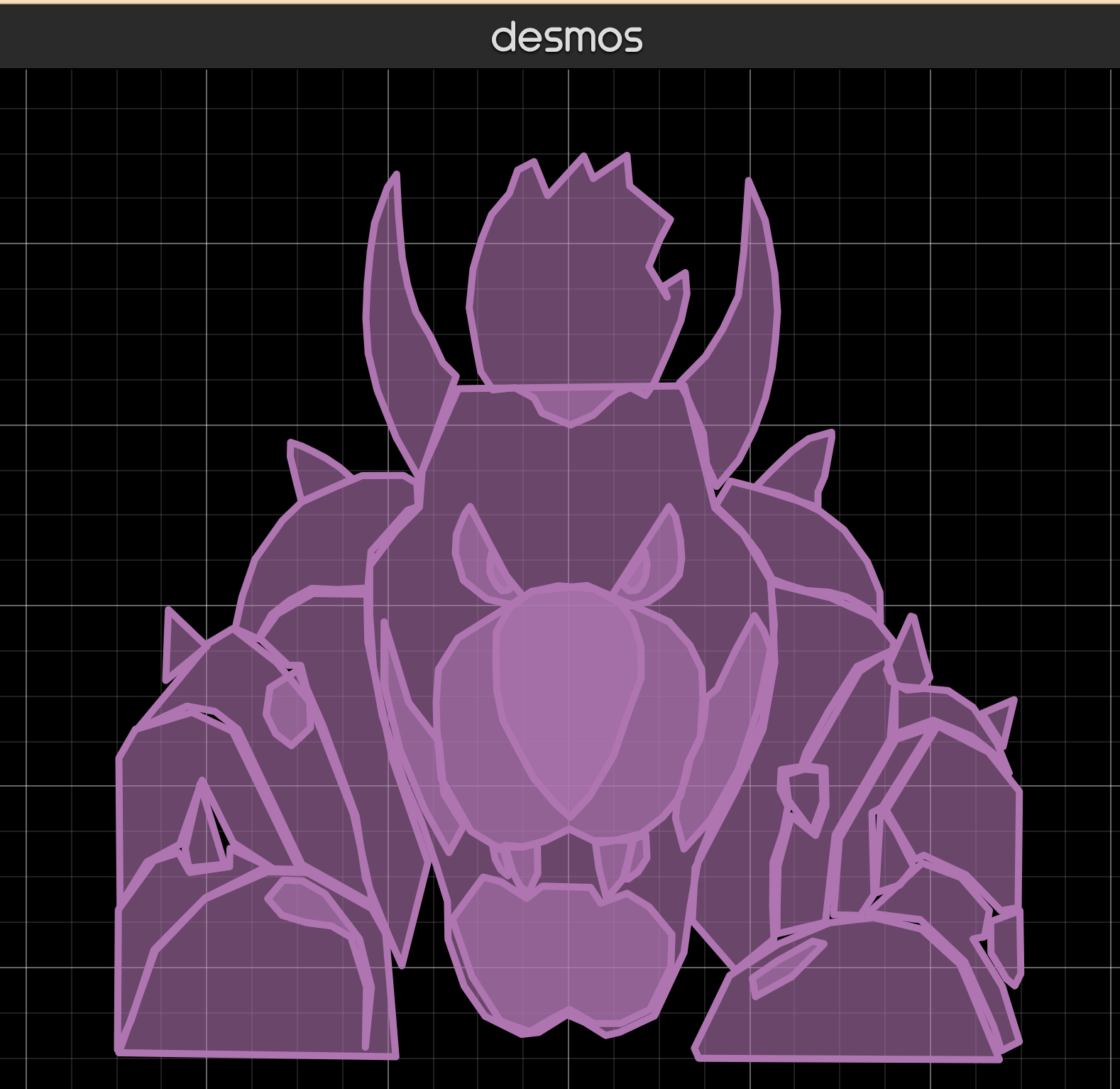 Drawing Bowser from Super Mario Bros in the Desmos Graphing Calculator.
38. Elliptic Curve Cryptography: A Basic Introduction
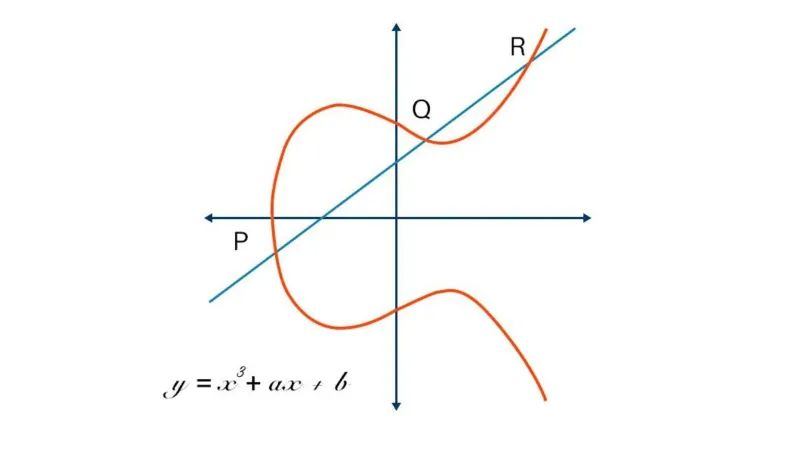 Elliptic Curve Cryptography (ECC) is a modern public-key encryption technique famous for being smaller, faster, and more efficient than incumbents.
39. The Secret Math Behind Every Creative Breakthrough
 Stop relying on "vibes" and "hustle." History rewards those with better models, not better speeches.
40. Safeguarding Your Passwords from Cracking: Understanding the Math Concepts
 Passwords that seem safe to us are vulnerable to math-based hacking. This is why using concepts like Password Space may be able to make more secure passwords.
41. Decoding Dynamic Programming
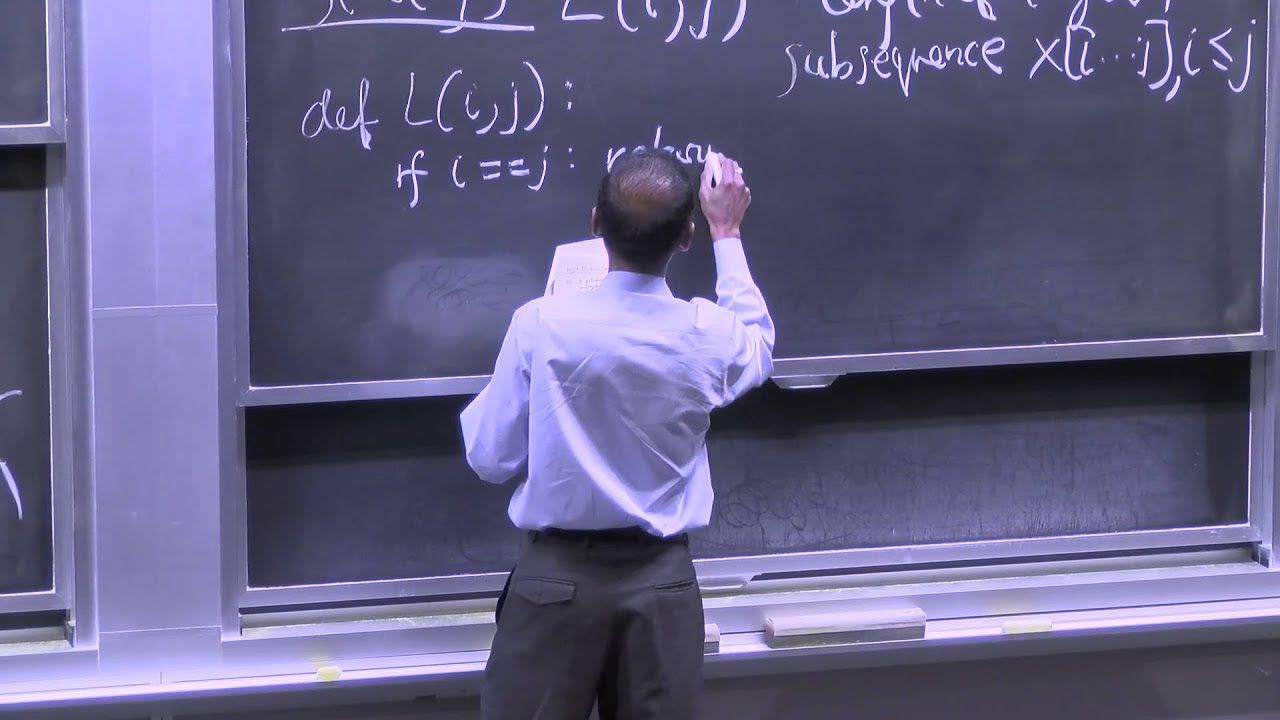 In this post, we will solve a problem involving dynamic programming without being aware of it.
42. Urpflanze JavaScript Library for Generative Art and Creative Coding
 Urpflanze is a javascript library to approach creative coding and generatve art
43. 85 Stories To Learn About Mathematics
 Learn everything you need to know about Mathematics via these 85 free HackerNoon stories.
44. You Can't Run from Math: Applications of Integration & Differentiation
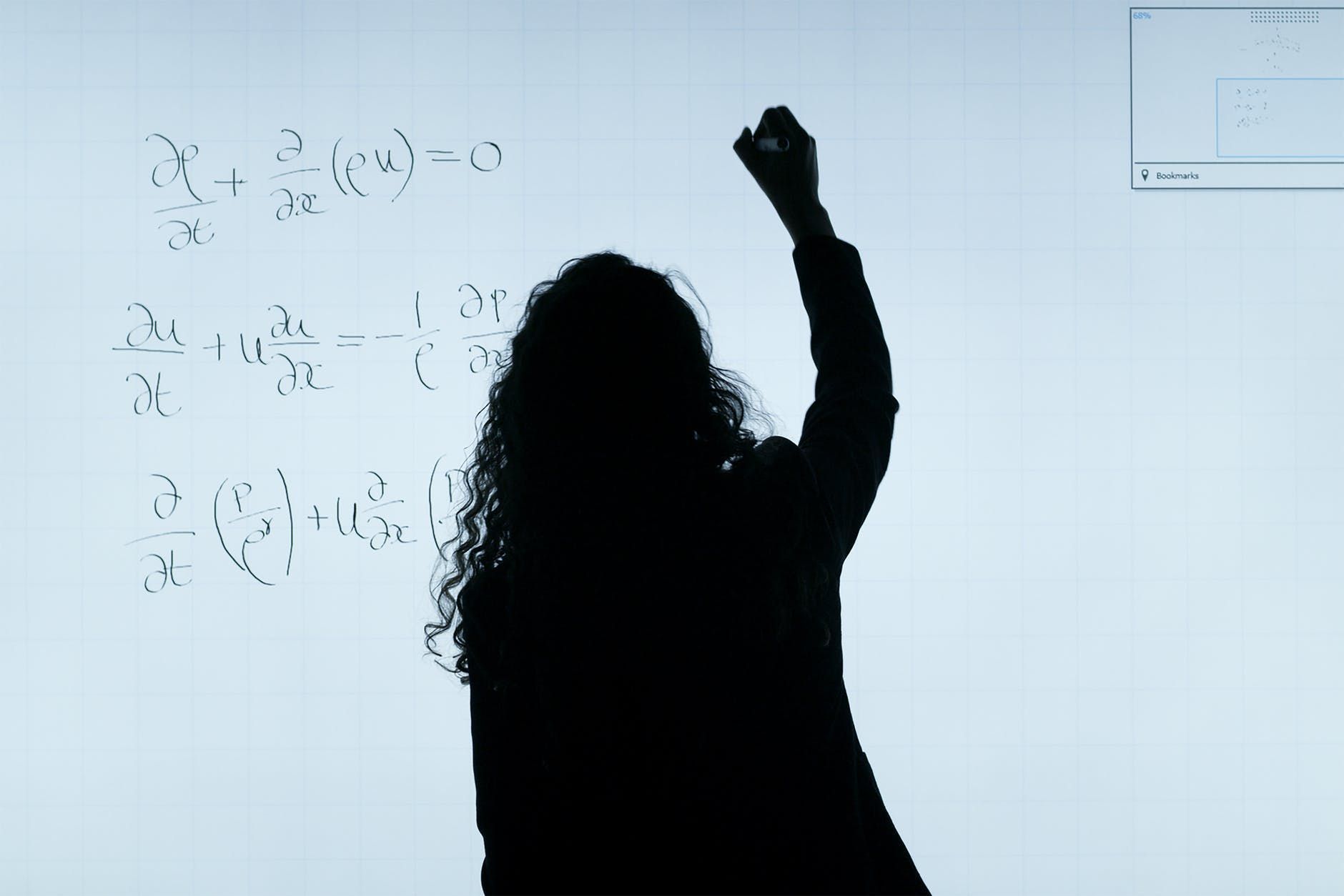 Learn all about Integration and differentiation with examples and understand their role in calculus.
45. Display a Number's Prime Digits
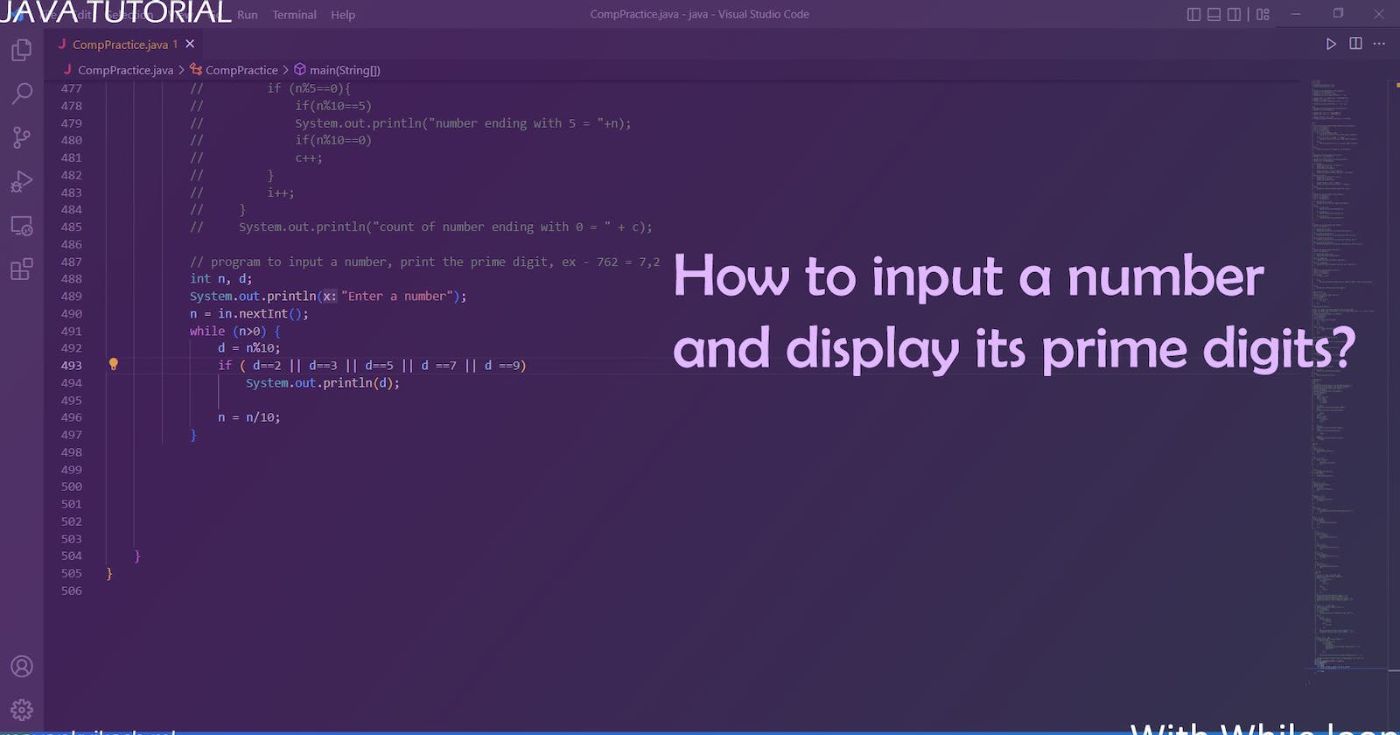 Program in java to input a number and display its prime digits.
46. 69 Poem
 69 was in his house
47. Metaphysics and Mathematics: The Intricate Web Connecting the Two
 In this exploration, we will dive into the intricate web connecting Mathematics, Metaphysics, and the computational mindset.
48. What is Collision Resistance in Cryptography?
 A short story about how national secrets, passwords, and financial data stays secret because of a small handful of smart people playing "Bet you can't"
49. An Insecure Pillar in Cybersecurity
 From Caesar's cipher to RSA. A deep dive into the inner workings of modern cryptography and its potential crumbling.
50. Thrilled to be Recognized as The HackerNoon Contributor of the Year - MATHEMATICS
 Merlyn is the teacher’s digital assistant, a multimodal solution built to give time back to teachers.
51. Daily Coding Problem: Triangular Numbers and Big Divisors
 Finding triangular numbers and their divisors
52. SQL's 50 Year Reign: Here's Why SQL Is Still Relevant Today
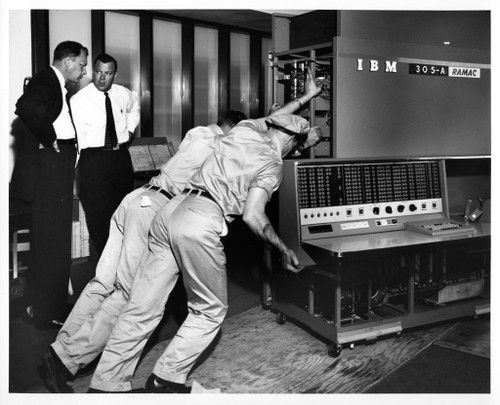 Dive into the detailed history of SQL's rise and reign over the past 50 years. They remained relevant by listening and adapting to the market.
53. Change Your Codes Behavior By Using Bitwise Operators
 Let’s dissect a weird bit flag program that took me a second to understand. in doing so, we’ll hopefully gain a more robust understanding of how bit masks and bitwise OR logic can manipulate values effectively.
54. [Explained] Machine Learning Fundamentals: Optimization Problems and How to Solve Them
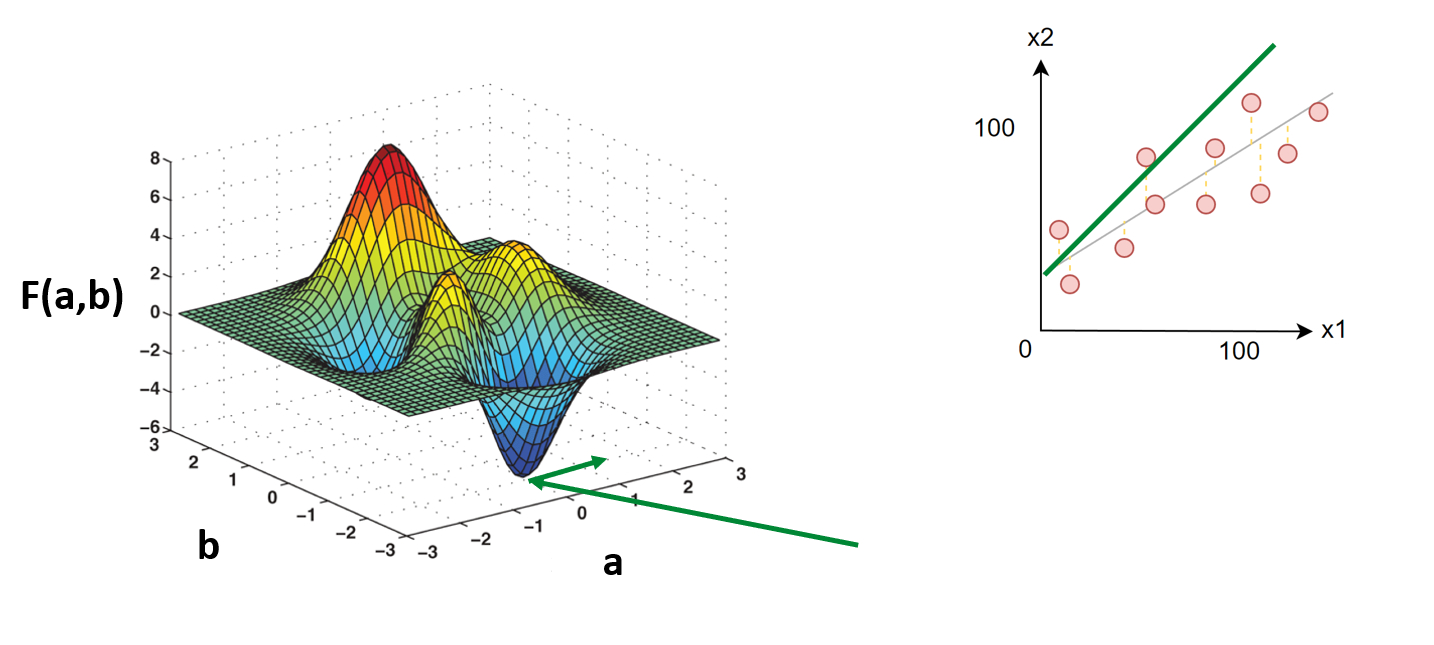 If you start to look into machine learning and the math behind it, you will quickly notice that everything comes down to an optimization problem. Even the training of neural networks is basically just finding the optimal parameter configuration for a really high dimensional function.
55. Binary Lifting and Its Applications
 Binary Lifting and its use in finding Lowest Common Ancestor (LCA). Explore this amazing algorithm that speeds up ancestor queries in the tree data structure.
56. The Smallest Bitcoin Miner Possible
 A Bitcoin miner could theoretically shrink to be as small as a few atoms in size while using less energy than we use to light our light bulbs.
57. What We Need to Know About Standard Deviation & Distance Formula
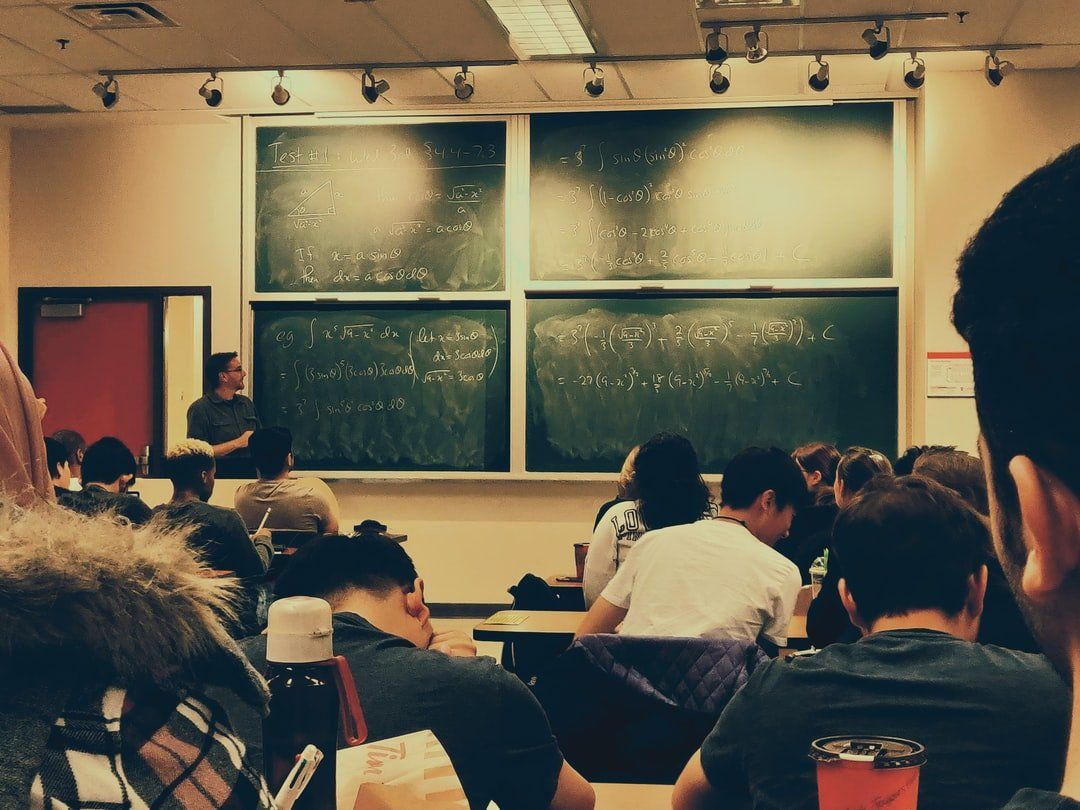 Standard Deviation Elucidation: Standard deviation is particularly used to catch the values of dispersed data of a set. It shows the result in two states, whether the answer lies near or away from the reference or mean position. It is important to realize that any Regular Distribution includes a Mean and Standard Deviation. The Regular Distribution is symmetrical about the Mean. The Standard Deviation determines the distribution's shape.
58. What Is Dynamic Programming?
 This article is for them, who have heard about Dynamic Programming and for them also, who have not heard but want to know about Dynamic Programming (or DP) . In this article, I will cover all those topics which can help you to work with DP .
59. What is Zero-Knowledge Proof ?
 Let’s explain exactly what that term means in one sentence:
60. zk-SNARK Concepts Explained In Different Levels of Complexity
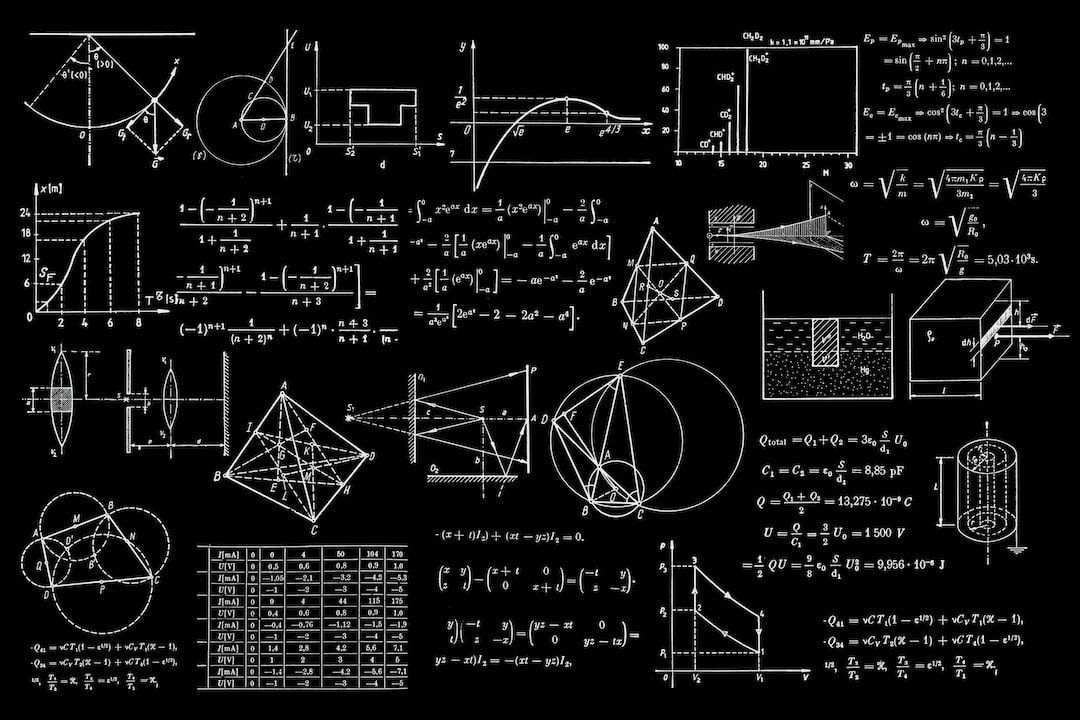 I’ve decided to write an ELI15 for zk-SNARK jargon since I’ve yet to come across something similar during my studies.
61. Natural Selection Vs. Intelligent Design: A Physicist's Perspective
 Our ability to come up with random numbers can reveal if we are part of a design in disguise. Are we? The age old question is in the reach of quantum biology.
62. Understanding Color Space Transform Using The Moving Least Squares Method
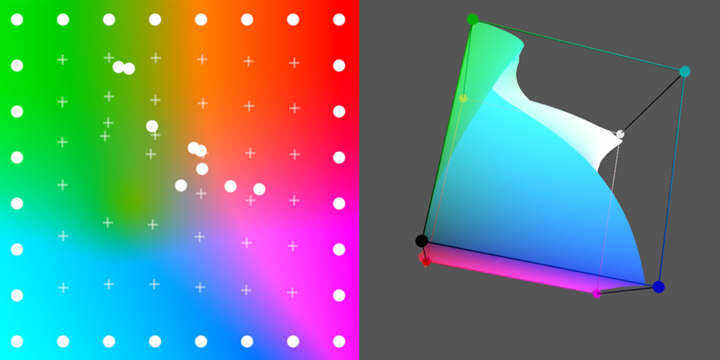 Dive into ImageMetalling to jazz up your images by tweaking color spaces with some cool geometric distortion tricks!
63. Bank Discount.
 The time in bank discount is always the number of days from the date of discounting to the date of maturity.
64. I Really Struggled With Math Because My Teachers Were Horrible
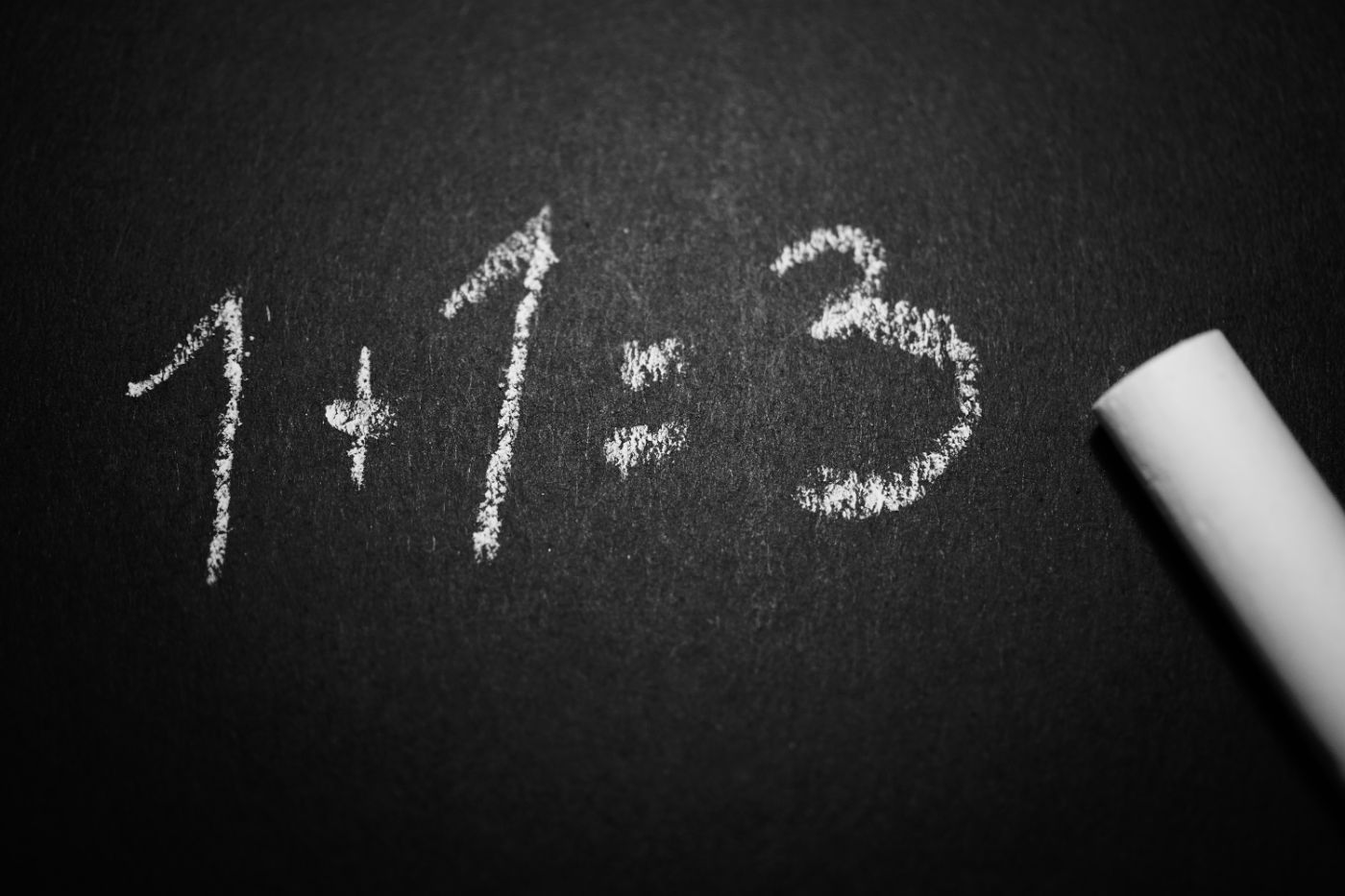 I really struggled with Math at a point cause my teachers were horrible.
65. How I Built a Simple Report Card Program in Java for 15 Subjects Part 2
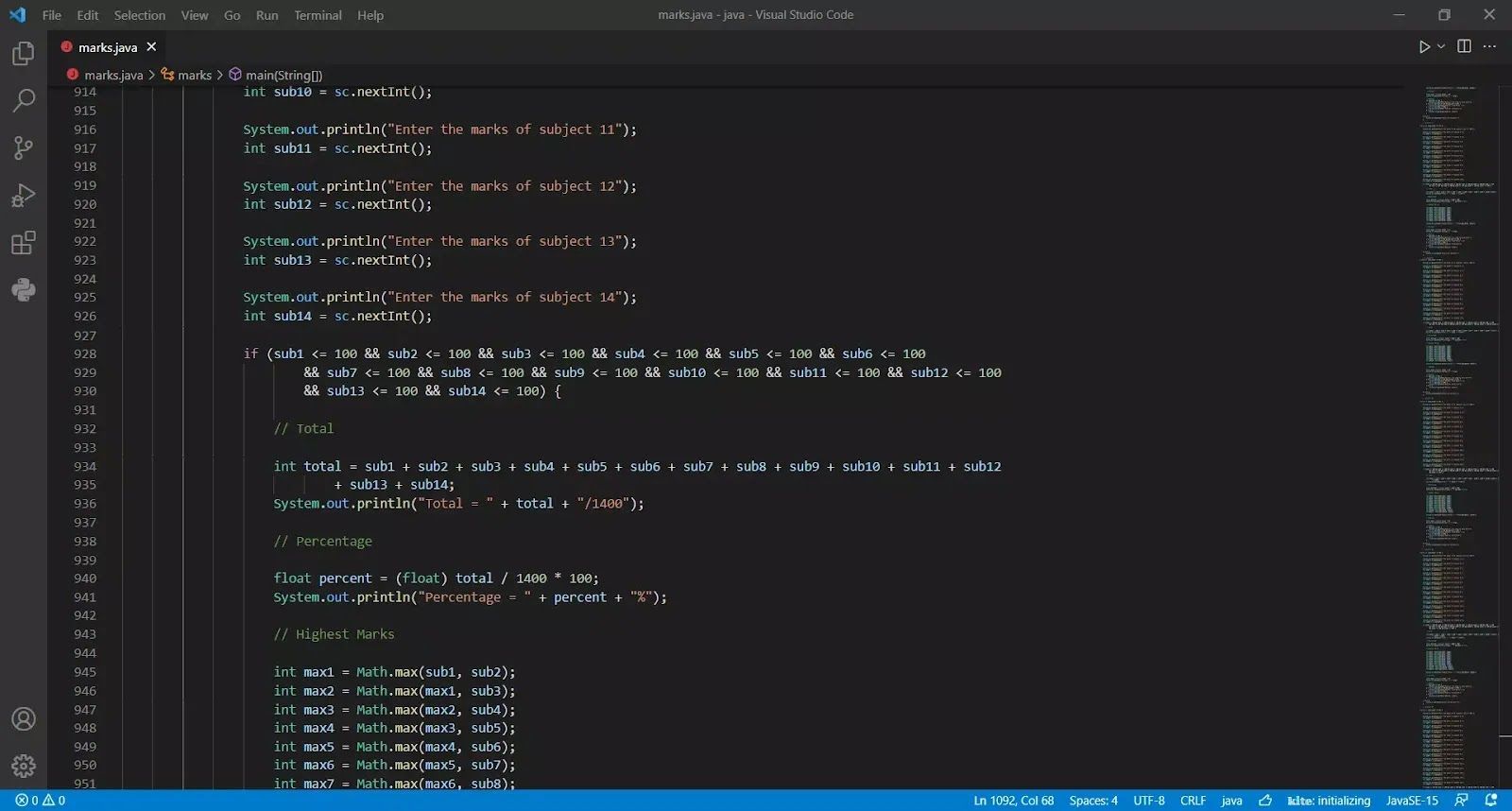 Write a program to take marks of 15 subjects from the user and display the Total, Percentage, Highest Marks, Average, and Remarks.
66. Embed Github Gists in your Hacker Noon Stories
 The Hacker Noon editor now supports embedding Github gists.
67. Metaphysics and Mathematics 2: The Complex Space of Prime Numbers
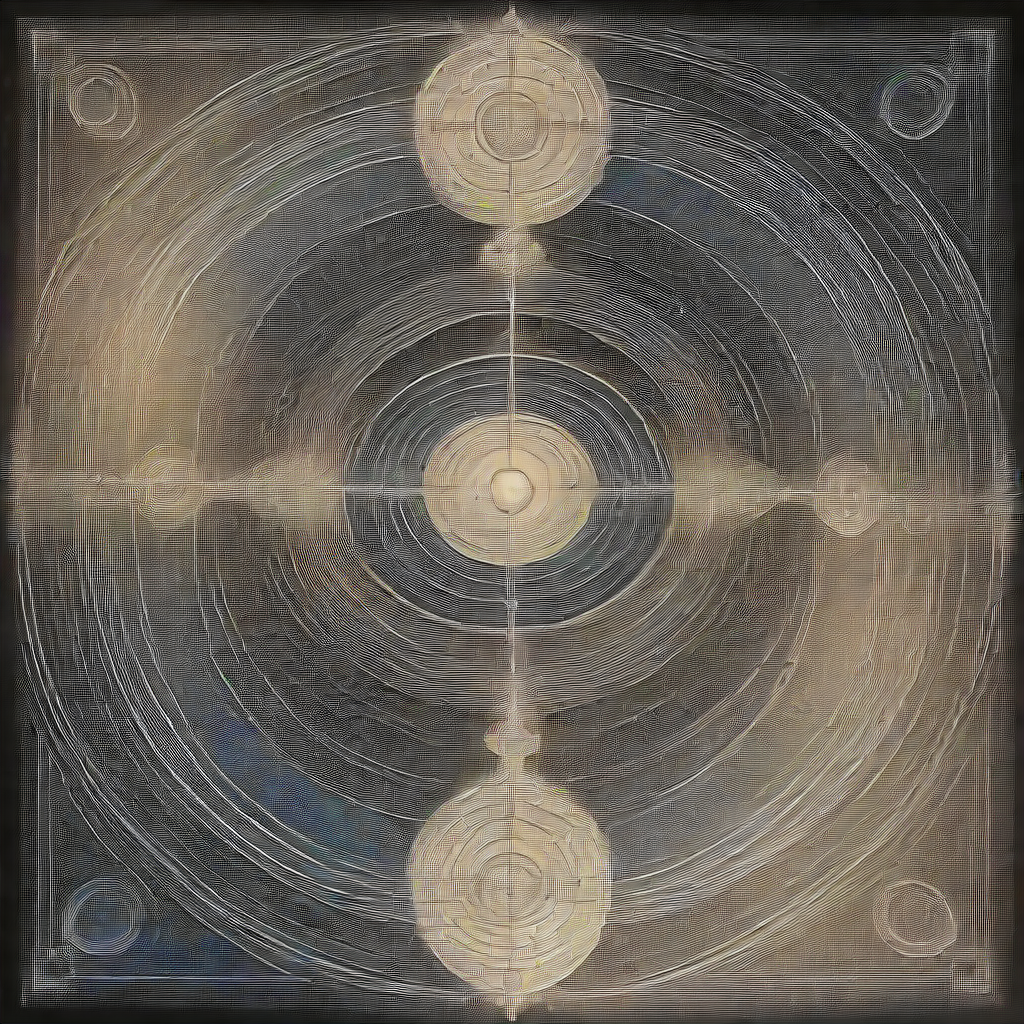 How the relationship between Metaphysics and Mathematics give raise to the complex P=NP space
68. SeqGen: The Library I Created for Sequence Generation
 In this short article, we will take a look at a library I wrote for the sequence generation called SeqGen.
69. On Zero-Knowledge Proofs And Why They Matter
 There is a lot of enthusiasm for the application of zero-knowledge proof systems, at Dusk Network we’ve developed the open-source PLONK zero-knowledge proof system. It can be used for many things, and what better way to demonstrate its potential with an example!
70. 5 Ways to Get Kids Interested in Stem
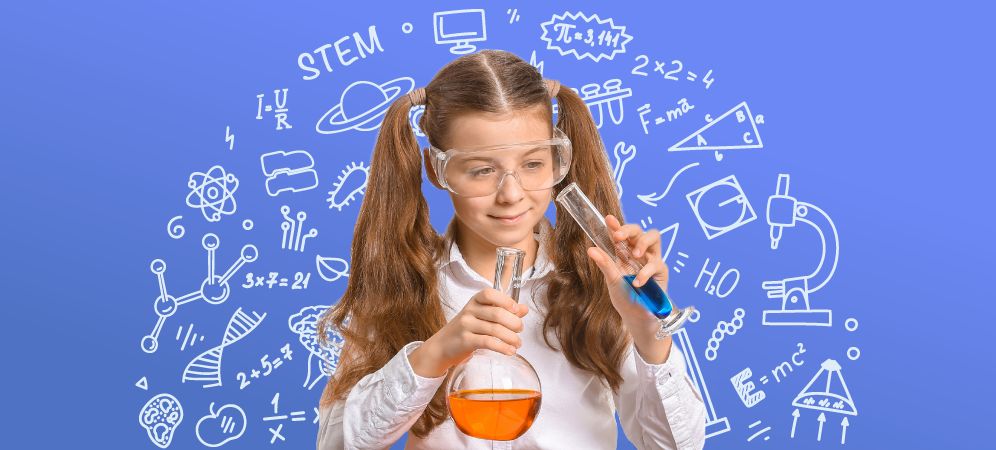 Studying STEM has become crucial for students who want to be part of an innovative, rapidly growing industry with excellent career prospects.
71. New Formula Could Make AI Agents Actually Useful in the Real World
 A mathematical framework for optimizing large language models in multi-agent systems using a formal objective function balancing brevity and context.
72. The Story of Machine Proofs - Part II
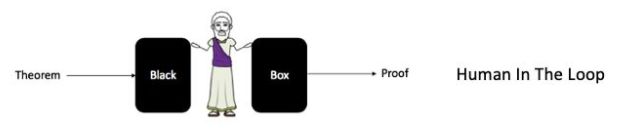 Automated theorem proving,
73. Why AI is a Fear-Driven Discipline
 People are scared of AI. According to Genpact research:
74. The Mathematical Analysis of Logic by George Boole - Table of Links
 The Mathematical Analysis of Logic, by George Boole, is part of the HackerNoon Books Series. Read this book online for free on HackerNoon!
75. Shakespeare Meets Google's Flax
 Some are born great, some achieve greatness, and some have greatness thrust upon them.
William Shakespeare, Twelfth Night, or What You Will
76. Time Space Breakthrough, Ancient Memory Systems & An I-Ching Inspired Hyper-Stack Scheduler
 How a computational time space breakthrough inspired a 64-Cell Hyper-Stack Scheduler (HSS).
77. Introduction to Threshold Signatures
 Today we’re announcing cross-chain zaps integration into the Symbiosis protocol.
78. Expressing Gains in PID Controllers Through Mathematical Notation
 In this paper, we analyze the mathematical representations of PID controller gains used to tune the algorithm.
79. A Clever Formula for Logarithm
 One of the best mathematical tools ever developed is the logarithm of a number. It has been used extensively in the past for the simplification of lengthy arithmetic calculations. The standard way of using the technique is via tables of common logarithms. The method of using these tables is well known and has been in use for decades. In this article, we will talk about a lesser known method of finding log of a number without using the tables.
80. Geometrical Constants in Equilateral Triangles: Part I

81. Reasons Why Should Students Give More Emphasis on Derivatives and Integrals

82. The Manual and Digital Ways of Calculating Factorization
 The factor is the numeral that can easily be divided into other numerals. It is to divide a numeral equally. If we have to divide 6, we are going to use 1, 2, 3, and 6. No other numerals can be used to divide it as they wouldn’t give the one numeral that is equally divisible. Factoring refers to the process of finding numbers so that results would be taken by multiplication. For this, we have to find out the highest common factor then divide it to have the result.
83. Python Tutorial: Recursive Function Debunked
 This Python Tutorial about the Recursive Function outlines the basic principles and methods to use recursion as a method of automating your software.
84. Daily Coding Problem: Computing Big Exponentials
 Calculating high exponentials with a simple algorithm
85. Can’t Buy Me Love: An Argument for Implementing Illiquidity
 Mapping human values into code. Hint: its hard to measure them in bitcoin.
86. How to Kalman Filter Your Way Out
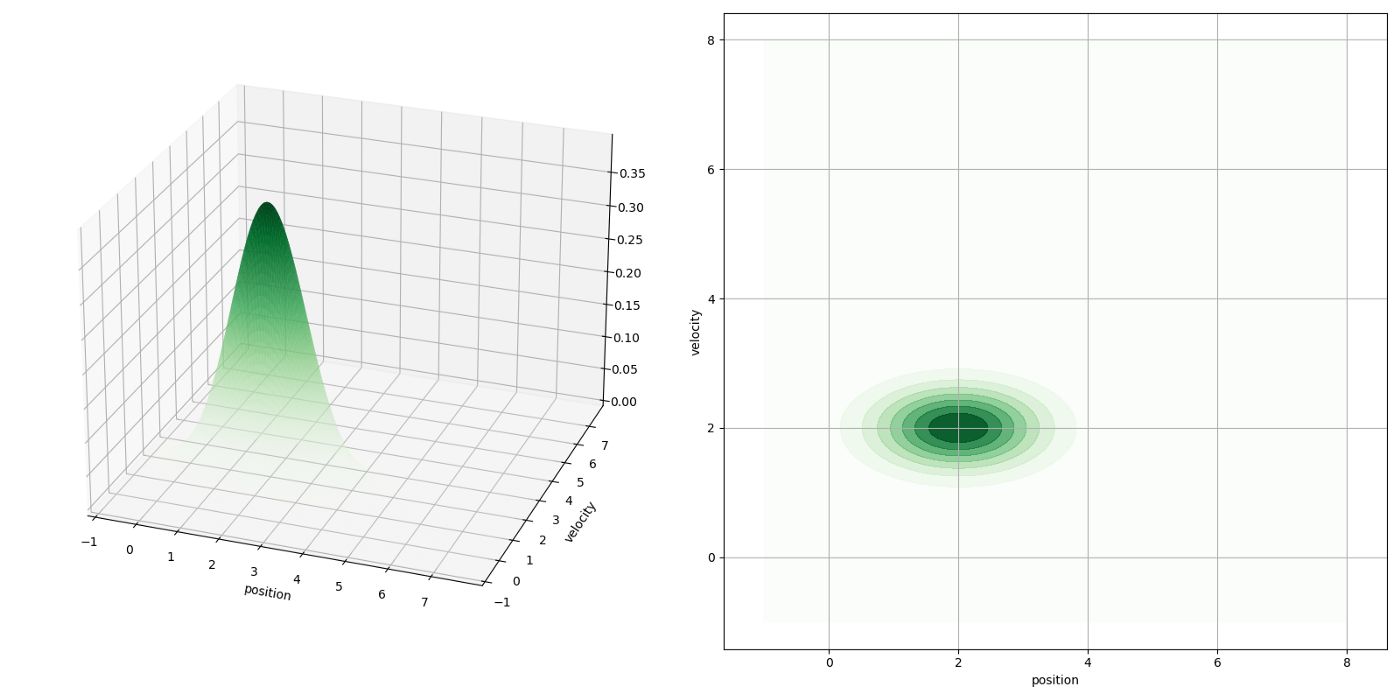 Learn how to use Kalman filters to minimize uncertainty with multi-sensory arrays
87. Python Libraries For Data Science
 Top Data science libraries introduction of The Python programming language is assisting the developers in creating standalone PC games, mobiles, and other similar enterprise applications. Python has in excess of 1, 37,000 libraries which help in many ways. In this data-centric world, most consumers demand relevant information during their buying process. The companies also need data scientists for achieving deep insights by processing the big data.
88. The Digital Universal Drachma: A Paradigm for a Global Private-Public Cryptocurrency
 A bold re-envisioning of the fundamentals behind blockchain technology and economic theory, in this paper Chitose Nakamoto suggests a middle ground in crypto.
89. Causal Analysis – Experimentation (AB Testing) and Statistical Techniques
 Causal analysis background and overview of different techniques to perform a causal analysis.
90. Deep Learning for Modeling Audio-Visual Correspondences
 Human perception is multidimensional and a balanced combination of hearing, vision, smell, touch, and taste. Recently, many pieces of research have tried to step forward on the road of improving machine perception by transitioning from single-modality learning to multimodality learning.
91. Motivation from Mathematics: Hire for Slope, not Y-Intercept
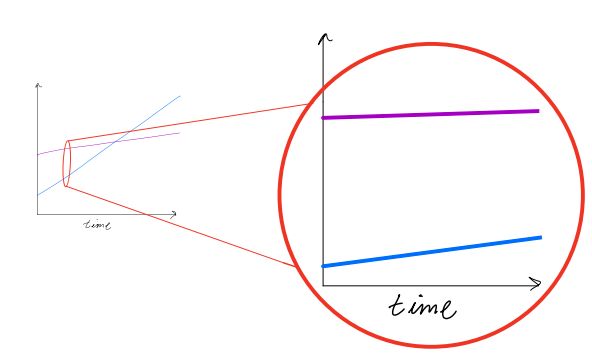 Forget about the y-intercept; slope is the only thing that matters in the long run.
[92. How Mental Models and Mathematics Help Solve
Engineering Problems](https://hackernoon.com/how-mental-models-and-mathematics-help-solve-engineering-problems)
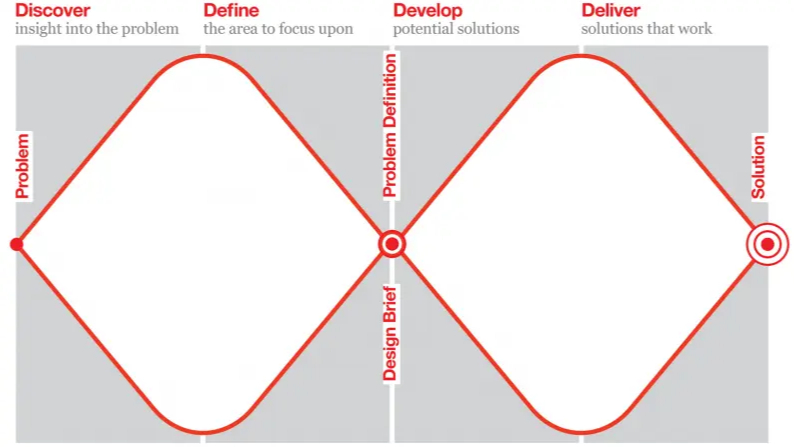 We’ll describe the problem-solving thought process by an engineer, based on a real-world problem. And how to approach this process more systematically.
93. How to Kalman Filter Your Way Out (Part 2: Updating Your Prediction)
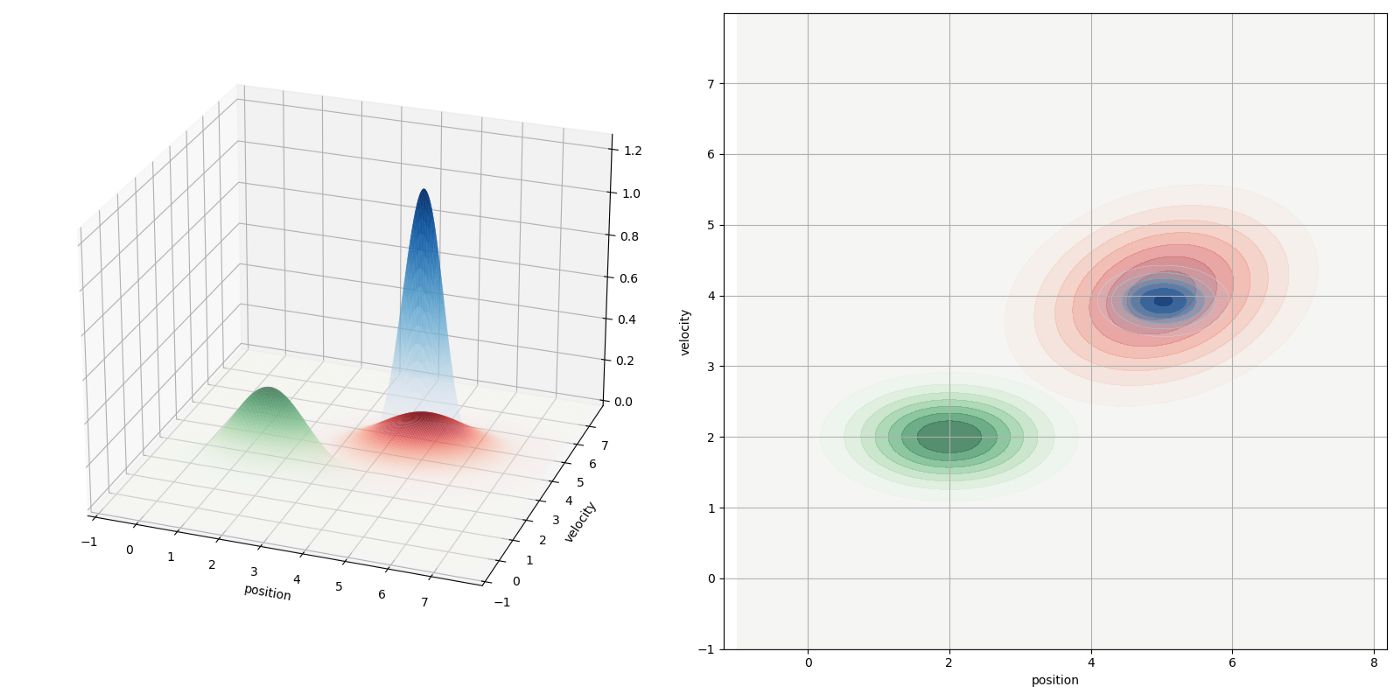 Part II describes how to use Kalman filters to minimize uncertainty when using multi-sensor arrays
94. The Concept of Numbers for a Y-Generation Organic Processing Unit
 Whether it's consciously or subconsciously, we use numbers every single moment of our lives. Numbers help us navigate in what we refer to as real life, as they help us set fixed determinations of concepts that are impossible to comprehend otherwise, eliminating the need for "lagging."
95. WriteUp — Fantastic times tables
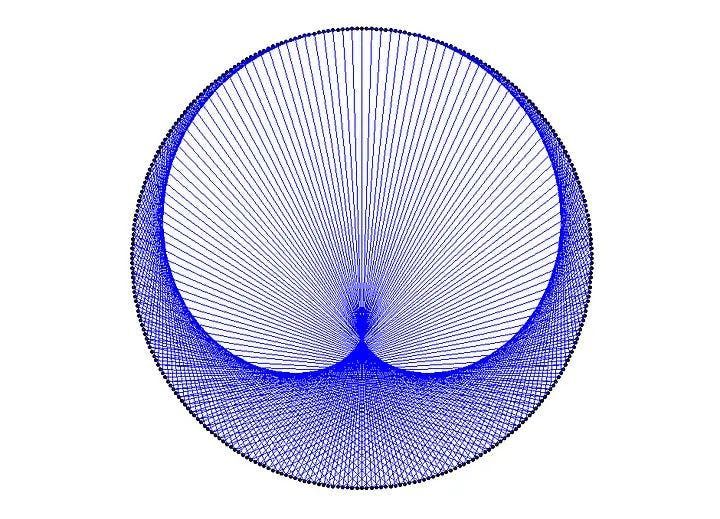 Drawing times tables on circles with Python and turtle graphics.
96. Why Data Lies (and Your Model Might Too): The Curious Case of Simpson’s Paradox
 Simpson’s Paradox is a cognitive trap that traps data-crunchers and machine learning tinkerers.
97. Breaking Down Secretary Problem
 What did you think of when you had a crush on someone? Did you fantasize about marriage with him/her? When you were in some serious relationship, did you plan marriage with your partner? How did the relationship turn out? Some relationships turn into a marriage, and some don’t. Hearing stories of many friends, I see extremely few people being in a relationship (and later marrying) with only one person whole over their life.
98. The Gambler's Ruin Explained
 10-K Diver explains the gambler's ruin.
99. Art + Science + Scripture = Bible Math
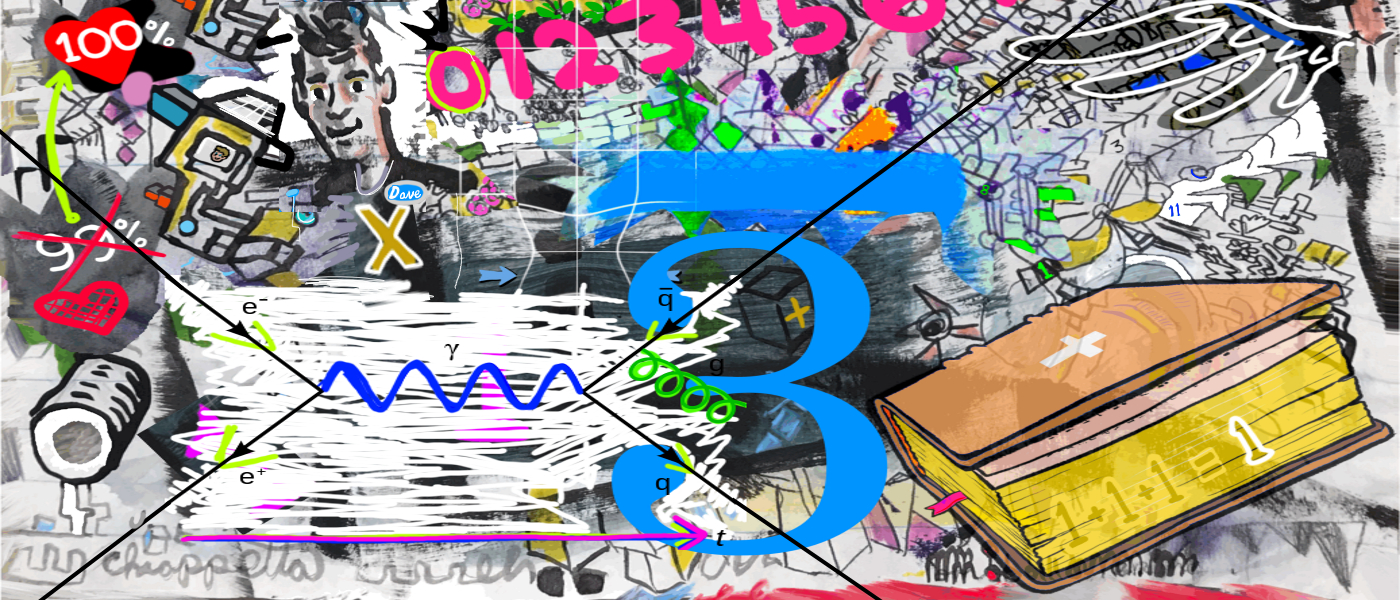 This science/scripture/art article known as Bible Math came about in a most-riveting, creative, and spiritual way. For over two decades, I have been leading weekly Bible Discussion Groups and studying the Bible with people on an individual mentoring level. In the course of these spiritual adventures, as part of the City of Angels International Christian Church, I am typically delighted to share the gospel with all who are willing to listen and put the word of God into practice. Such delight is especially true of the following mathematics-focused Bible study.
100. Maths Education is Broken—Here’s How We Can Fix It
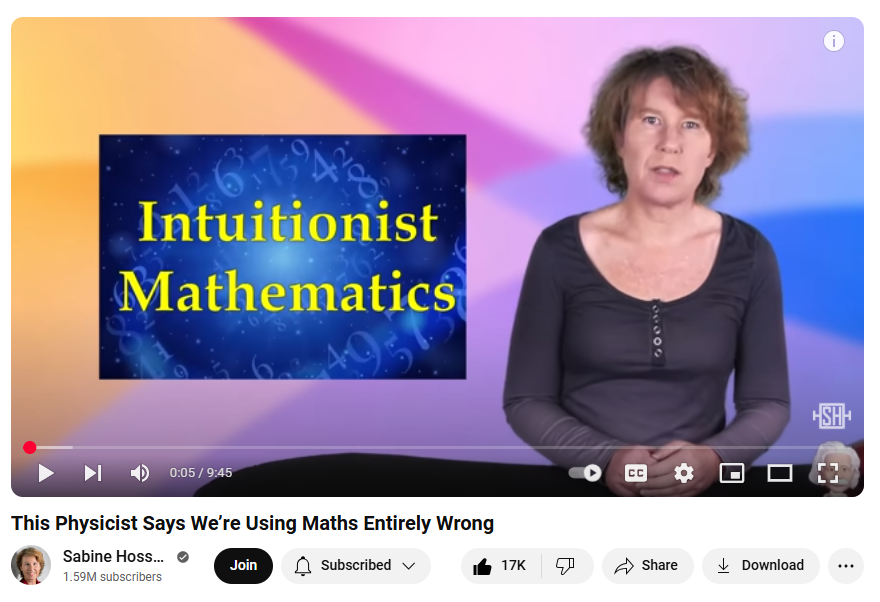 Dr. Sabine shares her views on Dr. Nicolas Gisin's 'Intuitive mathematics'. I too had an opinion of what intuitive mathematics is about, and it involves TikTok.
101. Basic of Cryptography
 What is Cryptography?
102. CFG Tree Enumeration: Mastering Pairing Functions & Bijections
 Learn how modular pairing addresses nonterminal rule variability for efficient, unique tree decoding.
103. Overlapping Rectangles: A Daily Coding Problem
 How to calculate the area size of two overlapping rectangles with an algorithm using go.
104. How to become a Lightning Calculator by Anonymous - Table of Links
 How to become a Lightning Calculator by Anonymous is part of the HackerNoon Books Series. Read this book online for free on HackerNoon!
105. Introduction to Cryptography: Vigenère Cipher [Part 2]
 Hi again and welcome back to part 2 of the basic cryptography. Previously we discuss about what is cryptography and how fundamental and ancient problem it is in communication science. We talk about ceaser's cipher and how easy it is to break. We also talk about Substitution Cipher which was slight improvement to Ceaser' cipher but can easily be cracked using Frequency analysis technique.
106. Diffie-Hellman & Its Simple Maths: A Quick Explanation for Web Developers🙆🏻♂️
 In order to understand the Diffie-Hellman algorithm, one must understand the discrete logarithm problem in Maths.
107. What If P vs NP Was Never a Problem—But a Mirror?
 In the end, this model portrays complexity and intelligence as two sides of the same process: the universe knowing and ever-complexifying itself ad infinitum.
108. Pseudo-Mathematical Proof of All Things Being Skills You Can Get Better At
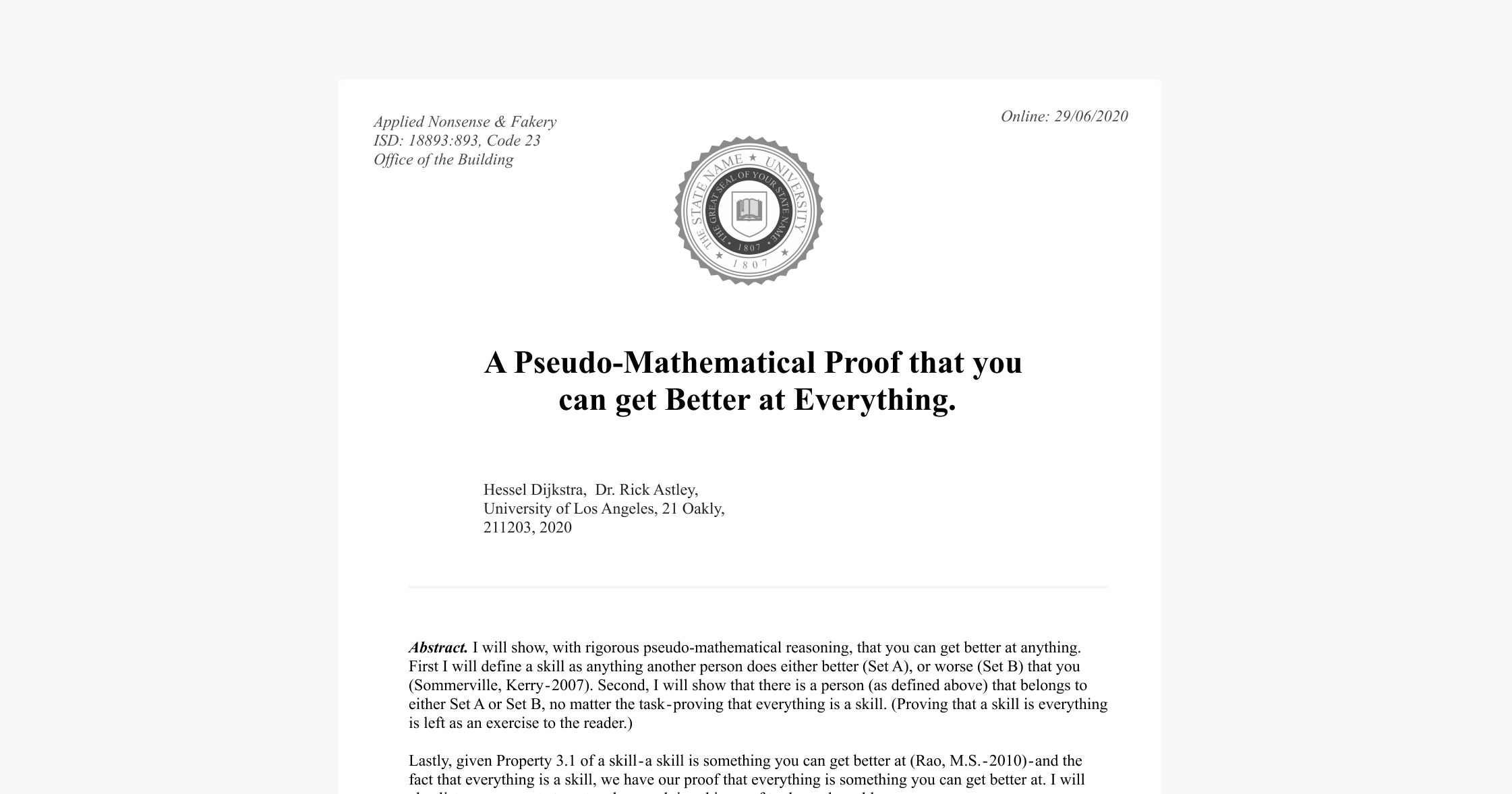
109. Extending Stochastic Gradient Optimization with ADAM
 Discover gradient descent and its variants, including Adam optimizer. Learn how Adam simplifies machine learning optimization with efficiency and adaptability!
110. BBS Signatures Using Weil Pairings
 BBS signatures allow one person to sign many documents efficiently by using elliptic curve parings. I've put an example on github to show how it works.
111. AI And Machine Learning Are Our Best Bet To Keep Saving The World From Climate Catastrophe
 Many equations apply to Nuclear Fusion including the Maximum Entropy Principle. Fusion increases entropy. Think of unsolved equations relating to Nuclear Fusion as hardness problems. Whoever solves these problems or contributed towards software that solves these problems, helped achieve one of the biggest tasks in modern engineering and physics this century. I will be honest, many of us (including a certain somebody) want to win the race. Many of us are also removing obstacles from the obstacle course.
112. Math in the Age of Machine Proof
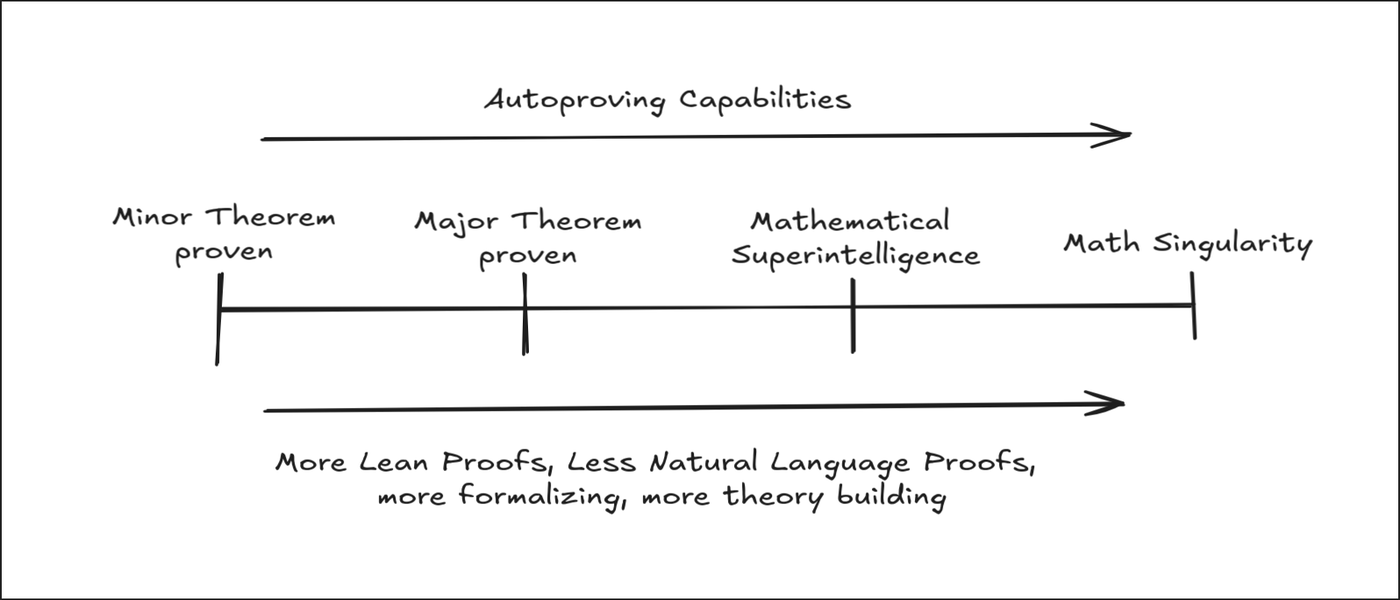 AI autoproving is changing mathematics forever. Explore the spectrum from current systems to the Math Singularity and what it means.
113. Vectors in Terms of Algebraic and Geometric interpretations
 Learn algebraic and geometric interpretations of vectors, how to visualize them in Python using numpy and matplotlib, and understand vector notation.
114. VR Math: The Difficulties of Moving Objects in Virtual Reality
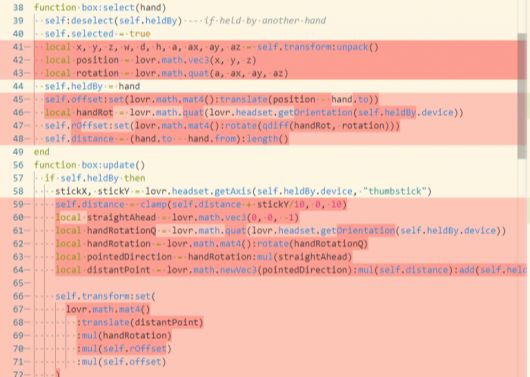 Applied game dev math can be tricky, but is really rewarding. Here’s a follow-up to Nevyn’s Twitter thread on his journey from incomprehensible mess to enlightened one-liner.
115. Goldman Sachs, Data Lineage, and Harry Potter Spells
 Goldman Will Dominate Consumer Banking
116. A Brief Introduction to Algorithmic Complexity
 It’s not just the running time; it’s the space usage too. We see algorithms used in pretty much every program that’s larger than a college project.
117. New Algorithm Brings Clearer, More Reliable Images to Medical Scans Using Electrical Signals
 Testing and refining a mathematical method to improve a medical imaging technology, focusing on both its theoretical foundations and its practical applications.
118. The Mathematical Foundation of Fairness: Proving Key Principles in an Economic Model
 This article provides a formal, step-by-step proof demonstrating the mathematical implications of unproductivity and anonymity within a fair economic framework.
119. A 42-Min Fall: A Physicist's Take on Falling Through The Centre of The Earth
 The classic 1864 science fiction novel by Jules Verne, titled "Journey to the Center of the Earth" has mesmerized many generations. The desire to discover the secrets inside the earth is perhaps as old as the desire to discover the secrets of the stars.
120. ZKPs Reshape The Way We Think About Identity
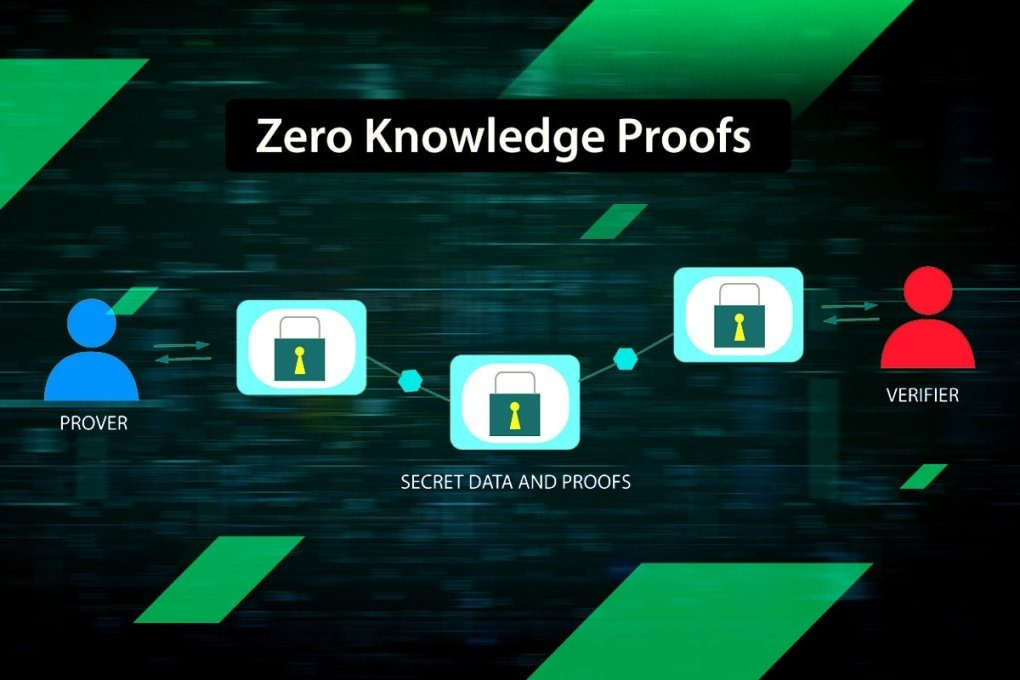 The key idea behind zero-knowledge proofs is to provide convincing evidence of knowledge without revealing the knowledge itself.
121. LLMs: Is NIST's AI Safety Consortium Relevant Amid California's SB 1047?
 One easy-to-identify issue, especially with the internet—in recent decades—is that development has been ahead of safety.
122. Introduction To The Convolution
 In this article, we are going to learn about the grayscale image, colour image and the process of convolution.
123. What is Linear Algebra?
 Discover the basics of linear algebra for machine learning with practical examples using Python and Manim for visualizing concepts effectively.
124. Introduction to Arithmetic Sequences
 An arithmetic sequence is a specific type of sequence in which the difference between two terms is “constant”.
125. Winning in Online Skilled Gaming… Err… Gambling! A Look at Optimistic+ and More
 This series of articles covers the techniques and gyan on winning in skilled games which are variants of Roulette, Wheel of Fortune and Baccarat.
126. The Canadian Interest Rule.
 This rule of computing interest appears in some Canadian text-books, and, though simply a modification of other rules, is worthy of notice.
127. Cambridge and Dublin Mathematical Journal
 The universe of conceivable objects is represented by 1 or unity.
128. Equation of Payments.
 The time for such payment is called the equated time.
129. How to Add Two Columns at Once.
 Much of the information here contained is compiled from W. D. Rowland’s valuable little volume, entitled “How to become expert with figures.”
130. Tech Politics, Math, and Career
 Baakt Launch
131. What Are Ordered Monoids? Ordered Monoids Explained
 An ordered monoid is a pair (M <) where M is a monoid and < is a partial order on M.
132. The Infinite Jackpot No One Ever Pays For
 The St. Petersburg Paradox is a 300-year-old riddle that continues to punch holes in economic theory and how modern AI systems are taught to think.
133. The calculus of logic by George Boole - Table of Links
 The calculus of logic by George Boole is part of the HackerNoon Books Series. Read this book online for free on HackerNoon!
134. General Solution of Elective Equations.
 This is a known transformation in logic, and is called conversion by contraposition, or negative conversion.
135. General Theorems relating to Elective Functions.
 Of the general theorems I shall only exhibit two sets: those which relate to the development of functions, and those which relate to the solution of equations.
136. How to Make Change.
 Accuracy and rapidity in counting out change can best be acquired by practice behind the counter or at the cash-desk.
137. Instantaneous Addition.
 Accuracy should be first considered, then rapidity.
138. Theorems of Development.
 All equations are thus of equal significance which give, on expansion, the same series of constituent equations, and all are interpretable.
139. Write the first right-hand figure, add the first and second, the second and third, and so on
 Write the first right-hand figure, add the first and second, the second and third, and so on; then write the left-hand figure.
140. A Guide on How to Boost Function Performance and Achieve Execution Over 10 Million Times Faster
 I’ll share a fascinating story about Carl Friedrich Gauss, a mathematician, and show how his arithmetic shortcut can dramatically improve performance in Swift.
141. The Truth About Less Biased Data-Informed Predictive Policing
 Critics say it merely techwashes injustice
142. Interest Computations.
 Require the interest of $462.50 for one month and eighteen days at 6 per cent.
143. Proof of Multiplication in Ten Seconds.
 The unitate of a number is the sum of its digits reduced to a unit.
144. Advanced Risk Analytics: Hyperbolic Graph Clustering and Worst-Case Portfolio Optimization
 Uncover complex data structures with LSEnet's Differentiable Structural Information (DSI) and shield investments from market crashes using Indifference BSDEs
145. Laws of Syllogism deduced from the Elective Calculus.
 In the proposition, some Xs are Zs, both terms are particular-affirmative.
146. Worst-Case Portfolio Optimization and Stochastic Control References
 Explore foundational research in worst-case portfolio optimization, stochastic interest rate risk, and robust preferences.
147. Bates and Heston Model Numerics: CIR Process Simulation and Infinite Activity Jumps
 Explore numerical experiments for Bates and Heston models, featuring CIR process volatility modeling, infinite activity jumps, and exact simulation techniques
148. Short Method to Find the Interest of a Given Sum.
 In some respects this rule is superior to the well-known 60-day method of reckoning interest.
149. Mastering LSEnet: Automated Graph Clustering in Lorentz Hyperbolic Space
 Learn how LSEnet uses Differentiable Structural Information (DSI) and the Lorentz model to reveal natural data hierarchies via gradient backpropagation.
150. On Syllogism.
 I subjoin the results of a recent investigation of the Laws of Syllogism.
151. The Lightning Calculator’s Addition.
 The operator writes a line of figures, then another, and so on.
152. Distant Deep Teaching
 Abstract
153. 2026 Graph Analytics & Financial Risk Modeling: LSEnet vs. Stochastic Crash Optimization
 Explore LSEnet's automated clustering in hyperbolic space and advanced strategies for worst-case portfolio optimization against market crashes
Thank you for checking out the 153 most read blog posts about Mathematics on HackerNoon.
Visit the /Learn Repo to find the most read blog posts about any technology.